2013-2014 Legislation
AB 323 (Chesbro) - Organics Recycling - Support
Summary: AB 323 presents a package of policies that will drive the recycling of yard trimming and food scraps, not only resulting in a reduction of pollution and greenhouse gases, but also creating jobs and supporting a burgeoning industry. Status: AB 323 was held in Assembly Appropriations.
AB 513 (Frazier) - Rubberized Asphalt Concrete Market Development - Support
Summary: AB 513 provides a market development incentive program for Rubberized Asphalt Concrete. Status: The bill was amended in Senate Appropriations and passed off the Senate Floor. The bill signed by the Governor sets up a program that will need to be funded through the budget process. If it is successfully funded in the budget, the program will still go into effect on July 1. The bill was signed by the Governor on Oct. 3.
AB 1001 (Gordon) - Bottle Bill Modernization - Support
Summary: Modernize California's Bottle Bill Program. Status: This bill is no longer active.
AB 1021 (Eggman) - Sales Tax Exemption - Support
Summary: AB 1021 provides financial assistance in the form of sales tax exemption on equipment purchases to businesses that process or utilized recycled feedstock. Status: AB 1021 was held in Senate Appropriations and is no longer active.
AB 1022 (Eggman) CRT Glass Market Development - Support
Summary: Provide market-based incentive to in-state recyclers and manufacturers to utilize CRT glass in products. Status: AB 1022 was held on Suspense in Senate Appropriations and is no longer active.
AB 1023 (Eggman) - Investment in Recycling Market Development - Support
Summary: AB 1023 directs funding from the AB 32 Cap-and-Trade proceeds to provide incentives for waste reduction, recycling, composting and recycled content manufacturing projects. Status: AB 1023 was held in Assembly Appropriations. The bill is considered dead.
AB 1594 (Williams) Compostable Organics Management - Support
Summary: AB 1594 (Williams) will eliminate a loophole in state law that allows some yard trimmings and prunings that are used as landfill cover to count as being “diverted” from landfills. This state law virtually subsidizes the landfilling of this valuable material and is a major disincentive for recycling organics. Status: AB 1594 is sponsored by CAW. It has passed the legislature and been signed by Governor Jerry Brown.
AB 1699 (Bloom) Micro-beads - Support
Summary: Bans plastic microbeads from personal care products after 2019. Status: The bill passed through the Senate Committee for Environmental Quality on June 18th and the Senate Judiciary Committee on June 24. This bill is no longer active.
AB 1826 (Chesbro) - Organics Recycling - Support
Summary: AB 1826 will drive the recycling of yard trimming and food scraps by requiring commercial generators to subscribe to composting or anaerobic digestion service for their organic waste. Status: AB 1826 is sponsored by CAW. It has passed the legislature and been signed by Governor Jerry Brown.
AB 2284 (Williams-Correa) Household Batteries - Support
Summary: Product stewardship for household batteries
SB 405 (Padilla) Single Use Carryout Bags - Support
Summary: Prohibits stores from distributing single use plastic bags and allows the sale of reusable, paper, and (in certain jurisdictions) compostable plastic bags. Status: On 5/30/13, the bill fell short of the 21 votes it needed to make it off of the Senate Floor, 18-17. Reconsideration granted. Please read a statement from Executive Director Mark Murray.
SB 529 (Leno) Fast Food Packaging - Sponsor
Summary: Requires fast food chains to use food packaging that is compatible with local recycling and composting infrastructure. Status: This bill is no longer active.
SB 254 (Hancock and Correa) Mattress Recycling - Support
Summary: SB 254 will serve the dual purpose of increasing recycling and reducing illegal dumping of mattresses by requiring mattress manufacturers to establish and implement market based collection and recycling programs for used mattress. Status: SB 254 passed off the Assembly Floor in the final days of the session. It also passed the concurrence vote in the Senate. The Governor signed the bill on September 27, 2013.
SB 270 (Padilla, de León, and Lara) Single Use Grocery Bags - Support
Summary: Phases out single-use plastic grocery bags. Reusable, paper, and (in certain jurisdictions) compostable plastic bags can only be distributed with a minimum 10 cent charge. Includes standards and incentives for plastic bag manufacturers to transition to making reusable bags. Status: Governor Jerry Brown signed SB 270 into law!
SB 804 (Lara) - Conversion Technology - No Position
Summary: SB 804 would have changed the definition of Conversion Technology and could allow diversion credits for methods other than recycling and composting, including controversial waste-to-energy projects. Status: It is no longer active.
SB 1014 (Jackson) Pharmaceutical Take-Back Program - Support
Summary: Creates voluntary takeback programs to adopt model guidelines as established under SB 966 (Simitian). Status: Referred to Assembly Appropriations. Passed Assembly ESTM and BPCP committees on 6/17/14 and 6/24/14, respectively. Previously passed Senate Floor on 5/29/14. This bill is no longer active.
AB 323 (Chesbro) Organics Recycling
Summary
AB 323 presents a package of policies that will drive the recycling of yard trimming and food scraps, not only resulting in a reduction of pollution and greenhouse gases, but also creating jobs and supporting a burgeoning industry.
Position and Status
Status: AB 323 was held in Assembly Appropriations.
Description
AB 323 requires CalRecycle to overhaul regulations on landfill cover materials and organics management by clarifying that green waste used as alternative daily or intermediate cover no longer counts as diversion; analyzing the health and safety impacts of using MRF residual fines and compost overs as cover or for other beneficial uses; and, if deemed suitable, adopting performance-based standards by 2015 for their safe use while excluding residual fines from mixed-waste processing. The bill also requires CalRecycle to implement regulations by 2017 mandating that large-quantity commercial organics generators arrange for separate organics collection, with flexibility for different materials, generator types, and regions, while defining key terms such as “commercial solid waste” and “large-quantity commercial organics generator” and making technical conforming changes to existing law.
CAW Staff Contact
Erica Parker (916) 443-5422
Support
Biodegradable Products Institute
Breathe California
California Biomass Energy Alliance
California Climate and Agriculture Network
California Coastal Protection Network
California Compost Coalition
California League of Conservation Voters
California Resource Recovery Association
Californians Against Waste
Center for Biological Diversity
City and County of San Francisco
CleanWorld
Coalition for Clean Air
Environment California
FEED Resource Recovery
F.M. Booth Mechanical
GAIA
Green Sangha
Greenaction for Health and Environmental Justice
Harvest Power Inc.
Humboldt Waste Management Authority
Los Angeles Alliance for a New Economy
Lyles Construction Group
Marin County Hazardous and Solid Waste Management Joint Powers Authority
Napa Recycling and Waste Services
Natural Resources Defense Council
Northern California Recycling Association
Otto Construction
Peabody Engineering
Peninsula Sanitary Service, Inc
Planning and Conservation League
Recology, Inc.
Regatta Solutions, Inc.
Rethink Waste
Sierra Club California
Stanford Recycling Center Peninsula Sanitary Service, Inc.
StopWaste.Org
US Composting Council
Vasko Electric
Zanker
Opposition
County Sanitation Districts of Los Angeles County
Los Angeles County Solid Waste Management Committee/Integrated Waste Management Task Force
AB 513 (Frazier, 2013-14) - Rubberized Asphalt Concrete Market Development
Summary.
AB 513 provides a market development incentive program for Rubberized Asphalt Concrete. The bill was signed by the Governor on Oct. 3.
Position and Status
CAW supports. The bill was amended in Senate Appropriations and passed off the Senate Floor. The bill signed by the Governor sets up a program that will need to be funded through the budget process. If it is successfully funded in the budget, the program will still go into effect on July 1.
Description.
California still landfills or burns approximately 13.8 million out of the 40.8 million tires generated each year and exports an additional 9.6 million. While there are many uses for scrap tires, RAC continues to be one of the highest and best uses for them.
AB 513 will direct funding to local government paving programs that use recycled tires in the place of traditional asphalt. This not only recycles the tires, but also produces roads that are quieter, function better under wet and icy conditions, and last longer. The use of Rubberized Asphalt Concrete (RAC) also reduces long term paving and repaving costs.
CAW Staff Contacts.
Nick Lapis (916) 443-5422
Supporters.
Californians Against Waste
California Association of Recycling Market Development Zones
California State Association of Counties
AB 1001 (Gordon, 2013-14) - Bottle Bill Modernization
Summary. Modernize California's Bottle Bill Program
Position and Status: CAW supports. This bill is no longer active.
Detail:
• Increased Recycling/even playing field - closes the loophole on containers currently exempt due to size/type – juice drinks larger than 46 oz, adding aseptic, and paperboard containers
• Electronic reporting system - processors to report electronically, and distributor to transition to ETF
• Increased certification requirements for recycler
• suspend commingled rate at buyback centers for the next 3 years
• Expansion of Department role and authority in establishing recycling centers in unserved zones.
• Authorization of reduced operating hours for recycling centers serving specified unserved zones.
• Authorize supplemental handling fee for recycling centers in unserved zones.
• Temporary suspension of in-store take back obligation for retailers inspecified ‘unserved’ zones.
• Landowners and city and county cannot restrict the siting of a CZ recycler.
• Consolidation of CRV and Handling fee claim and reporting systems.
• Establishment of 3-tiered/volume-based HF payment system based on existing cost survey
• Affirm Local Conservation Corps as ‘core’ funding priority and update the current allocation as $21 million annually
• Strike $1.5 million grants for litter reduction program.
• Clarify 5-year history does not apply if new operator has no relationship to previous operator.
CAW Staff Contacts.
Tony Hackett (916) 443-5422
Current Language, Analyses and Votes.
Supporters:
Californians Against Waste
AB 1021 (Eggman, 2013-14) - Sales Tax Exemption
Summary:
AB 1021 provides financial assistance in the form of sales tax exemption on equipment purchases to businesses that process or utilized recycled feedstock.
Position and Status:
CAW Supports. AB 1021 was held in Senate Appropriations and is no longer active.
Description:
AB 1021 will add recycled content manufacturing and processing to the successful Advanced Transportation and Alternative Sources Manufacturing Sales and Use Tax Exclusion Program. This will provide an important incentive to recycle more materials and reintroduce more recyclable materials into California’s manufacturing economy.
CAW Staff Contacts: Nick Lapis (916) 443-5422
Current Language, Analysis and Votes
Supporters:
Californians Against Waste (sponsor)
Association of Postconsumer Plastic Recyclers
California Compost Coalition
California Electronic Asset Recovery
California Manufacturers & Technology Association
California Refuse Recycling Council
CarbonLITE Industries, LLC
Command Packaging
CR&R Waste and Recycling Services
Envision Plastics
Epic Plastics
Glass Packaging Institute
Institute of Scrap Recycling Industries, West Coast Chapter
Mojave Desert & Mountain Recycling Authority
Napa Recycling & Waste Services
Northern California Recycling Association
rePLANET Recycling
Republic Services, Inc.
SIMS Recycling Solutions
StopWaste.Org
Strategic Materials, Inc.
Talco Plastics
Turlock Recycling
Verdeco Recycling, Inc.
Waste Management
Western Plastics Association
Opposition:
None on file
AB 1022 (Eggman, 2013-14) CRT Glass Market Development
Summary.
Provide market-based incentive to in-state recyclers and manufacturers to utilize CRT glass in products.
Position and Status.
CAW supports. AB 1022 was held on Suspense in Senate Appropriations and is no longer active.
Description
New technology for television screens has taken over and demand for CRT devices has dropped dramatically. The end-use market for CRT Glass has dried up and many e-waste recyclers are stockpiling the CRT glass to unsafe levels. The market incentive payments to recyclers will help offset cost of separating out lead from the CRT Glass while the manufacturer payments will incentivize manufacturers to use the cleaned CRT glass over other materials.
CAW Staff Contacts.
Tony Hackett (916) 443-5422
Supporters:
Californians Against Waste
California Association of Recycling Market Development Zones
Glass Packaging Institute
Natural Resources Defense Council
Sims Recycling Solutions
AB 1023 (Eggman, 2013-14) - Investment in Recycling Market Development
Summary:
AB 1023 directs funding from the AB 32 Cap-and-Trade proceeds to provide incentives for waste reduction, recycling, composting and recycled content manufacturing projects.
Position and Status:
CAW Supports. AB 1023 was held in Assembly Appropriations. The bill is considered dead.
Description:
AB 1023 would create a market development program to provide incentives for projects and industries that have been identified to reduce their greenhouse gas emission through the increased use of recycled or composted materials. These include composting and anaerobic digestion, recycled glass container manufacturing, food processing, recycled paper and cardboard manufacturing and recycled plastic manufacturing.
CAW Staff Contacts: Nick Lapis (916) 443-5422
Current Language, Analysis and Votes
Supporters:
Californians Against Waste (sponsor)
California Association of Recycling Market Development Zones
Northern California Recycling Association
Waste Management, Inc.
AB 1594 (Williams, 2013-14) Compostable Organics Management
Summary. AB 1594 (Williams) will eliminate a loophole in state law that allows some yard trimmings and prunings that are used as landfill cover to count as being “diverted” from landfills. This state law virtually subsidizes the landfilling of this valuable material and is a major disincentive for recycling organics.
Position and Status. AB 1594 is sponsored by CAW. It has passed the legislature and been signed by Governor Jerry Brown.
Description.
Landfill operators are required to cover the active face of the landfill at the end of every day to prevent odors and risks to public health. The traditional material used for this purpose is soil. The next day, more garbage is placed on the soil and so it goes.
Operators have found that other materials such as processed green waste, auto shredder fluff, and tarps can also be used for this same purpose. These alternative cover materials are called Alternative Daily Cover (ADC).
Under AB 939, the state's waste reduction and recycling law the use of alternative daily cover is counted as recycling, and the materials are not considered "landfilled."
Californians Against Waste has no objection to the use of secondary materials, including green waste, for use as ADC or for other beneficial uses when other onsite materials are unavailable. We do remain strongly opposed to the concept of providing diversion credit for green waste that is used as ADC or for other beneficial uses at landfills.
There are valuable environmentally and economically beneficial markets for green waste and other woody waste materials that are being undermined by the use of these materials as landfill cover.
The initial rationale for providing diversion credit for green waste used as landfill cover was to create an incentive for collection at a time when end use markets for green waste composting remained uncertain. However today, the infrastructure has fully matured, and far from providing any benefit to the green waste composting infrastructure, the continued provision of diversion credit for the use of green waste as landfill cover threatens the very existence of the composting industry in California.
AB 1594 ends this practice.
CAW Staff Contacts.
Nick Lapis (916) 443-5422
Supporters
Agromin
Association of Compost Producers
Breathe California
Biodegradable Products Institute
California Biomass Energy Alliance
California Climate and Agriculture Network
California Coastal Protection Network
California Compost Coalition
California League of Conservation Voters
California Organics Recycling Council
California Resource Recovery Association
Californians Against Waste
Center for Biological Diversity
City and County of San Francisco
City of Thousand Oaks
Clean Power Campaign
CleanWorld
Coalition for Clean Air
Costa Mesa Sanitary District
County of Santa Barbara
CR&R Environmental Services
Ecology Center
Environment California
Frank M. Booth Design Build Company
Global Alliance for Incinerator Alternatives
Global Green USA
GrassRoots Recycling Network
Green Waste Recovery
Greenaction for Health and Environmental Justice
Integrated Waste Management Consulting
Los Angeles Alliance for a New Economy (LAANE)
Mayor Eric Garcetti, City of Los Angeles
Napa Recycling & Waste Services
Napa Recycling Compost
Natural Resources Defense Council
NatureWorks, LLC
Northern California Compost
Northern California Recycling Association
Northern Recycling Compost
Novamont
Peabody Engineering
Planning and Conservation League
Quackenbush Mountain Compost
Recology
Sierra Club California
Sonoma Compost
Synergex International
Tracy Delta Compost
Upper Valley Recycling Compost
US Composting Council
Vasko Electric, Inc.
Z-Best Composting
AB 1699 (Bloom, 2013-14) Micro-beads
Summary. Bans plastic microbeads from personal care products after 2019.
Position and Status. CAW Supports.
The bill passed through the Senate Committee for Environmental Quality on June 18th and the Senate Judiciary Committee on June 24. This bill is no longer active.
Description.
Micro-beads are pervasive in the environment, absorb persistent organic pollutants (long-lasting toxic chemicals like DDT, PAHs, PCBs [flame-retardants]) and other industrial chemicals, and are consumed by a variety of marine life, including the fish we harvest for food.
AB 1699 would prohibit, on or after January 1, 2019, the sale or promotion of personal care products, such as facial scrubs, soaps, and toothpastes containing plastic micro-beads.
CAW Staff Contact.
Tony Hackett (916) 443-5422
Current Language, Analyses and Votes.
Supporters:
All One Ocean
Attorney General, Department of Justice, State of California
California Association of Sanitation Agencies
Californians Against Waste
Campaign for Safe Cosmetics
Center for Biological Diversity
City of Los Angeles
Coachella Valley Water District
Environment California
Heal the Bay
Las Virgenes – Triunfo Joint Powers Authority
Los Angeles Waterkeeper
Natural Resources Defense Council
Ocean Conservancy
Ocean Voyage Institute/Project Kaisei
Plastic Free Seas
Plastic Pollution Coalition
Plastic Soup Foundation
San Luis Obispo Waterkeeper
Save Our Shores
Seventh Generation Advisors
Sierra Club California
Surfrider Foundation
Team Marine
The Five Gyres Institute
Turtle Island Restoration Network
WateReuse
AB 1826 (Chesbro, 2013-14) - Organics Recycling
Summary.
AB 1826 will drive the recycling of yard trimming and food scraps by requiring commercial generators to subscribe to composting or anaerobic digestion service for their organic waste.
Position and Status. AB 1826 is sponsored by CAW. It has passed the legislature and been signed by Governor Jerry Brown.
Update: Governor Jerry Brown signed AB 1826 into law!
Description.
Returning organic materials to soils drastically reduces the environmental impacts of landfills, reduces greenhouse gases, creates jobs, and helps sustain California's agricultural industry.
Despite California's robust recycling infrastructure for traditional recyclables, the state continues to landfill organic materials, such as yard trimmings and food scraps, at an alarming rate. In fact, food is the most prevalent item in our waste stream and a third of the material going to landfills is readily compostable.
It doesn't have to be this way. With strong policy leadership and a shift away from laws that incentivize the landfilling of this valuable material, California can become a leader in the recycling of organics.
AB 1826 would require businesses that generate a lot of food scraps or yard debris to sign up for recycling of this material.
Implementation of AB 1826: Statewide Organics Recycling
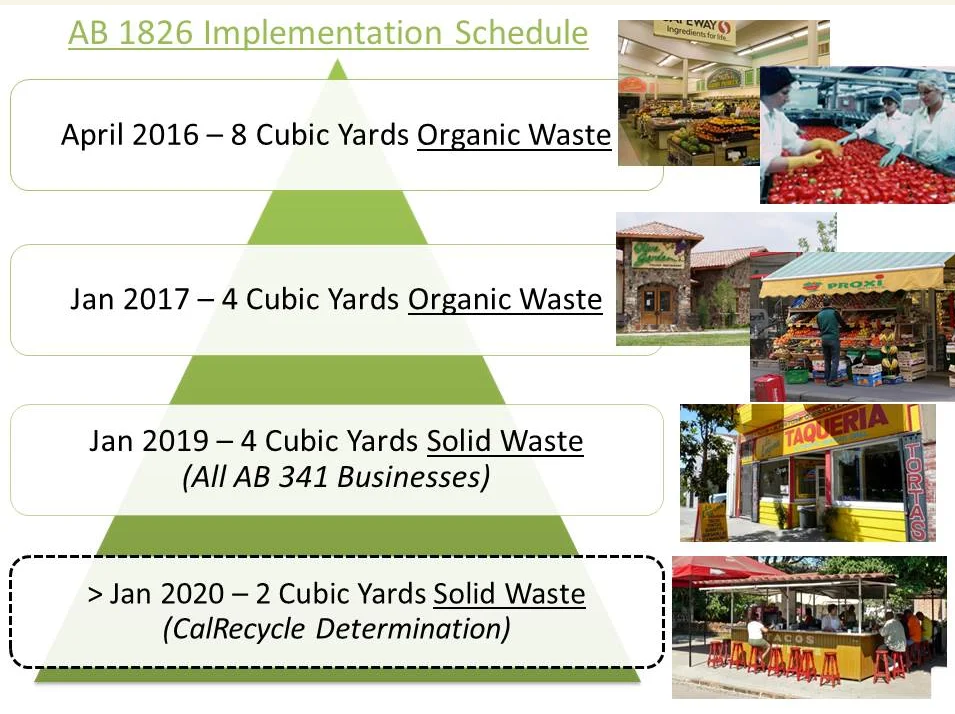
AB 1826 targets the lowest hanging fruit of the organic waste stream—the material thrown away by the state’s businesses. Restaurants, super markets, large venues, and food processors generate significant quantities of high quality food waste, and several states have already prohibited the disposal of this material. The bill lays out a measured phase-in of a commercial organics recycling program that will ensure that private sector can build the infrastructure necessary to handle the material.
AB 1826 builds on the success of the mandatory commercial recycling program established by AB 341. Beginning with the largest generators of food waste in 2016 and ramping down to the vast majority of businesses over several years, AB 1826 bill will require businesses to sign up for organics recycling service.
AB 1826 Timeline
January 1, 2016: Local jurisdictions shall have an organic waste recycling program in place. Jurisdictions shall conduct outreach and education to inform businesses how to recycle organic waste in the jurisdiction, as well as monitoring to identify those not recycling and to notify them of the law and how to comply.
April 1, 2016: Businesses that generate 8 cubic yards of organic waste per week shall arrange for organic waste recycling services.
January 1, 2017: Businesses that generate 4 cubic yards of organic waste per week shall arrange for organic waste recycling services.
August 1, 2017 and Ongoing: Jurisdictions shall provide information about their organic waste recycling program implementation in the annual report submitted to CalRecycle. (See above for description of information to be provided.)
Fall 2018: After receipt of the 2016 annual reports submitted on August 1, 2017, CalRecycle shall conduct its formal review of those jurisdictions that are on a two-year review cycle.
January 1, 2019: Businesses that generate 4 cubic yards or more of commercial solid waste per week shall arrange for organic waste recycling services.
Fall 2020: After receipt of the 2019 annual reports submitted on August 1, 2020, CalRecycle shall conduct its formal review of all jurisdictions.
Summer/Fall 2021: If CalRecycle determines that the statewide disposal of organic waste in 2020 has not been reduced by 50 percent of the level of disposal during 2014, the organic recycling requirements on businesses will expand to cover businesses that generate 2 cubic yards or more of commercial solid waste per week. Additionally, certain exemptions may no longer be available if this target is not met.
Background & Overview
In October 2014 Governor Brown signed AB 1826, a CAW sponsored bill, by Assemblymember Chesbro, requiring businesses to recycle their organic waste on and after April 1, 2016, depending on the amount of waste they generate per week. This law also requires that on and after January 1, 2016, local jurisdictions across the state implement an organic waste recycling program to divert organic waste generated by businesses, including multifamily residential dwellings that consist of five or more units (please note, however, that multifamily dwellings are not required to have a food waste diversion program). Organic waste (also referred to as organics throughout this resource) means food waste, green waste, landscape and pruning waste, nonhazardous wood waste, and food-soiled paper waste that is mixed in with food waste. This law phases in the mandatory recycling of commercial organics over time, while also offering an exemption process for rural counties. In particular, the minimum threshold of organic waste generation by businesses decreases over time, which means an increasingly greater proportion of the commercial sector will be required to comply.
CAW Staff Contacts.
Nick Lapis (916) 443-5422
Supporters
American Biogas Council
Association of Compost Producers
Biodegradable Products Institute
Bioenergy Association of California
Breathe California
California Biomass Energy Alliance
California Climate and Agriculture Network
California Coastal Protection Network
California Compost Coalition
California League of Conservation Voters
California Resource Recovery Association
Californians Against Waste (sponsor)
Castaway Solutions
Center for Biological Diversity
City and County of San Francisco
Clean Power Campaign
CleanWorld
Coalition for Clean Air
Community Alliance with Family Farmers
Costa Mesa Sanitary District
CR&R Environmental Services
Ecology Center
Environment California
Frank M Booth Design Build Co.
Global Alliance for Incinerator Alternatives
Global Green USA
Grassroots Recycling Network
Greenaction for Health and Environmental Justice
GreenWaste Recovery
Harvest Power
Inland Empire Disposal Association
Los Angeles Alliance for a New Economy
Napa Recycling & Waste Services
Natural Resources Defense Council
NatureWorks, LLC
Northern California Recycling Association
Novamont
Peabody Engineering
Planning and Conservation League
Recology
Sierra Club California
Solid Waste Association of Orange County
Sonoma Compost
StopWaste.Org
Synergex International
US Composting Council
Vasko Electric, Inc
AB 2284 (Williams-Correa, 2013-14) Household Batteries
Summary. Product stewardship for household batteries
Position and Status. CAW Supports.
CAW supports. The bill has been referred to the Assembly Natural Resources Committee, where it is expected to be heard April 7th.
Description.
Would create the Primary Battery Stewardship Act requiring manufacturers to share in the responsibility to design, fund and operate a convenient household generated alkaline battery recycling program in California.
CAW Staff Contacts.
Tony Hackett (916) 443-5422
Current Language, Analyses and votes.
Supporters:
CA Against Waste
CA Product Stewardship Council (co-sponsor)
City of Sacramento (co-sponsor)
National Electrical Manufacturers Association (NEMA)
SB 254 (Hancock and Correa, 2013) Mattress Recycling
Summary
SB 254 will serve the dual purpose of increasing recycling and reducing illegal dumping of mattresses by requiring mattress manufacturers to establish and implement market based collection and recycling programs for used mattress.
Position: Supported by Californians Against Waste
Status: Signed by the Governor
Current language, analyses and votes
CAW Staff Contact - Tony Hackett (916) 443-5422
Supporters:
Californians Against Waste
California Apartment Association
California Chamber of Commerce
Californians for Mattress Recycling
California Retailers Association
California State Association of Counties
City and County of San Francisco
City of El Cerrito
City of Martinez
City of Richmond
City of Sunnyvale
Contra Costa Co. Board of Supervisors
Costa Mesa Sanitary District
Deslee Textiles, USA Inc.
Ecology Action
Good Will
Got Sleep?
International Sleep Products Association
Jerome’s Furniture of San Diego-Riverside
League of California Cities
Leigh Fibers: Recycling Solutions
LFP Mattress Recycling
Mattress Discounters
McRoskey Mattress Company of San Francisco and Palo Alto
Marin County Hazardous & Solid Waste Management Joint Powers Authority
Napa Recycling & Waste Services
Natural Resources Defense Council
Northern California Recycling Association
Republic Services, Inc.
Rural County Representatives of California
Select Comfort/The Sleep Number Bed
Sit’n Sleep
Sleep Country USA
Sleep Train, Inc.
SMART: Secondary Materials and Recycled Textiles Association
Sonoma Co. Waste Management Agency
Tempur-Pedic
West Contra Costa Integrated Waste Management Authority
SB 270 (Padilla, de León, and Lara, 2013-14) Single Use Grocery Bags
Summary
Phases out single-use plastic grocery bags. Reusable, paper, and (in certain jurisdictions) compostable plastic bags can only be distributed with a minimum 10 cent charge. Includes standards and incentives for plastic bag manufacturers to transition to making reusable bags.
Governor Jerry Brown signed SB 270 into law!
Description
The total cost to manage plastic bag litter in our streets, our waterways, and even our recycling facilities and landfills amounts to millions being unnecessarily spent each year.
This bill seeks to reduce those costs by prohibiting single-use plastic grocery bags in supermarkets and drugstores starting July 1, 2015. By July 1, 2016, smaller grocery stores and convenience stores must also comply with the requirements. Other bags (paper, reusable, and in some jurisdictions, compostable) are allowed only with a ten-cent minimum charge. Local ordinances adopted before September 1, 2014, which currently cover a third of the state's population, would be protected under a grandfathering clause.
This bill also seeks to protect and create green jobs by creating standards and incentives for plastic bag manufacturers to transition to making reusable bags.
FAQ - Living Without Single-Use Plastic Grocery Bags
CAW Staff Contacts
Mark Murray (916) 443-5422
Current Language, Analyses and Votes
Support
All One Ocean
Azul
Bag It
Black Surfers Collective
BlueGreen Alliance
California Association of Environmental Health Administrators
California Coastal Coalition
California Coastkeeper
California Grocers Association
California League of Conservation Voters
California Retailers Association
Californians Against Waste
Center for Biological Diversity
Center for Oceanic Awareness, Research, and Education
ChicoEco, Inc.
City of Clayton
City of Concord
City of Culver City
City of Los Angeles
City of Long Beach, Vice Mayor Suja Lowenthal
City of Manhattan Beach
City of Oceanside
City of Palm Desert
City of Palo Alto
City of Sacramento
City of Sacramento, Council Member Kevin McCarty
City of San Diego, Council Member Sherri Lightner
City of San Jose, Council Member Sam Liccardo
City of San Luis Obispo, Council Member John Ashbough
City of San Rafael
City of Santa Monica
City of Sunnyvale
City and County of San Francisco
Clean Oceans Competition
Clean Water Action
Colorado Ocean Coalition
Command Packaging
Community Environmental Council
Contra Costa Clean Water Program
Costa Mesa Sanitary District
County of Contra Costa
County of Los Angeles, Supervisor Gloria Molina
County of Los Angeles, Supervisor Mark Ridley-Thomas
County of Marin
County of San Mateo
County of Santa Barbara
County of Santa Clara
Don't Waste LA
Earthwise Bag Company Inc.
Environment California
Five Gyres Institute
Global Alliance for Incinerator Alternatives
Global Green USA
Green Cities California
Green Sangha
Green Vets Los Angeles
Green Waste Recovery
Heal The Bay
Help Animals India
Hidden Resources
Humboldt Waste Management Authority
Latino Coalition for a California Bag Ban
Los Angeles Alliance for a New Economy
Los Angeles Leadership Council
Los Angeles Neighborhood Council Alliance of River Communities
Napa Recycling and Waste Services
Napa Valley CanDo
Natural Resources Defense Council
Ocean Project
Pacoima Beautiful
Planning and Conservation League
Plastic Free Himalayas
Plastic Free Seas
Plastic Paradise
Plastic Pollution Coalition
Plastic Soup Foundation
Plasticbaglaws.org
Recology
Republic Services
Reusable Bag Association
Sachamama
Santa Barbara Channelkeeper
Seventh Generation Advisors
Sierra Club California
Silicon Valley Leadership Group
Surfrider Foundation
Sustainable Coastlines Hawaii
Target
Team Marine, Santa Monica High School & Santa Monica College
Town of Yucca Valley
Turtle Island Restoration Network
United Food and Commercial Workers
Western Center on Law and Poverty
Wildcoast
World Society for the Protection of Animals
Zero Waste Humboldt
Zero Waste San Diego
11,345 individuals (petition)
SB 405 (Padilla, 2013-14) Single Use Carryout Bags
Summary
Prohibits stores from distributing single use plastic bags and allows the sale of reusable, paper, and (in certain jurisdictions) compostable plastic bags.
Position and Status
CAW Supports. On 5/30/13, the bill fell short of the 21 votes it needed to make it off of the Senate Floor, 18-17. Reconsideration granted.
Description
The total cost to manage plastic bag litter in our streets, our waterways, and even our recycling facilities and landfills amounts to millions being unnecessarily spent each year.
This bill seeks to reduce those costs by prohibiting single use plastic bags in supermarkets and drug stores starting January 1, 2015. By July 1, 2016, convenience stores must also comply with the requirements and all stores must sell certified reusable bags that have met specific performance standards.
CAW Staff Contacts
Mark Murray (916) 443-5422
Supporters:
California Grocers Association
California Retailers Association
Green Chamber of Commerce
United Food & Commercial Workers Western States
ChicoBag
Earthwise Bag Company, Inc.
Green Vets Los Angeles
Alameda County Waste Management Authority
California State Association of Counties
Central Contra Costa County Solid Waste Authority
City and County of San Francisco
City of Arcata
City of Avenal
City of Clayton
City of Culver City
City of El Cerrito
City of Encinitas
City of Eureka
City of Los Angeles, Council Member Paul Koretz
City of Long Beach
City of Mill Valley
City of Nevada City
City of Pacifica
City of Palm Desert
City of Palo Alto
City of Rolling Hills Estates
City of Sacramento
City of San Francisco
City of San Juan Bautista
City of San Rafael
City of Santa Barbara
City of Solana Beach
City of Sunnyvale
City of Union City
Clean Water Action
Clean Water California
Contra Costa Clean Water Program
County of Los Angeles
County of San Francisco
County of San Mateo
County of Sonoma
Humboldt County Board of Supervisors
Humboldt Waste Management Authority
Los Angeles County Board of Supervisors
Los Angeles County Integrated Waste Management Task Force
Marin County Hazardous & Solid Waste Management Joint Powers Authority
Santa Clara County Board of Supervisors
Santa Clara County Recycling & Waste Reduction Commission
State Lands Commission Staff
California Resource Recovery Association
Global Recycling Council
GreenWaste Recovery Inc.
Hidden Resources
Marin Sanitary Service
Northern California Recycling Association
Peninsula Sanitary Service, Inc.
Recology
UrbanOre
Zanker Road Resource Management, Ltd.
Azul
BagIt
California Association of Environmental Health Administrators
California Coastal Coalition
California Coastkeeper Alliance
Californians Against Waste
Clean Water Action
Ecology Action
Environment California
Green Sangha
Heal the Bay
La Mode Verte Productions
Napa Valley CanDo Environment Group
National Hispanic Environmental Council
Natural Resources Defense Council
Ocean Conservation Society
Pacifica Beach Coalition
Pacifica’s Environmental Family
Planning and Conservation League
Plasticbaglaws.org
Plastic Pollution Coalition
Save Our Shores
Seventh Generation Advisors
Sierra Club California
Surfrider Foundation
Team Marine – Santa Monica High School
The 5 Gyres Institute
Turtle Island Restoration Network
Wildcoast
William C. Velazquez Institute
Zero Waste San Diego
SB 529 (Leno, 2013-14) Fast Food Packaging
Summary
Requires fast food chains to use food packaging that is compatible with local recycling and composting infrastructure.
Position and Status
CAW Sponsored. This bill is no longer active.
Description
California law mandates a 75% statewide diversion goal by 2020.
This bill would require fast food chains to use food packaging materials that can be locally recycled or composted by July 1, 2014. In addition and consistent with CA law, the bill mandates that the packaging materials meet specific diversion goals in subsequent years, starting with a 25% goal by 2016 and ending with a 75% recycling or composting rate by 2020.
This is a producer responsibility measure that would increase the supply of recovered plastics and paper waste.
CAW Staff Contacts
Tony Hackett (916) 443-5422
Current Language, Analyses and Votes
Supporters
Azul
BagIt
California Coastal Coalition
California Coastkeeper Alliance
Californians Against Waste (sponsor)
California Teamsters Public Affairs Council
City and County of San Francisco
Ecology Action
Environment California
Green Chamber of Commerce
Green Cities California
Heal the Bay
La Mode Verte (LMV) Productions
Los Angeles County Integrated Waste Management Task Force
Napa Valley CanDo
Natural Resources Defense Council
Northern California Recycling Association
Ocean Conservation Society
Pacifica's Environmental Family
Planning & Conservation League
Save Our Shores
Seventh Generation Advisors
Sierra Club California
Surfrider Foundation
Turtle Island Restoration Network
World Centric
5 Gyres Institute
SB 804 (Lara, 2013-14) - Conversion Technology
Summary:
SB 804 would have changed the definition of Conversion Technology and could allow diversion credits for methods other than recycling and composting, including controversial waste-to-energy projects.
Position and Status: CAW opposed the bill prior to its amendment but has no position on the current bill. It is no longer active.
Description:
This bill could have opened the door for controversial and unproven waste-to-energy conversion technologies and enable them to be counted as recycling and/or renewable energy even though most conversion technologies are designed to turn waste into fuel, which can only be used once and then the resource is destroyed.
CAW Staff Contacts: Nick Lapis (916) 443-5422.
SB 1014 (Jackson, 2013-14) Pharmaceutical Take-Back Program
Summary
Creates voluntary takeback programs to adopt model guidelines as established under SB 966 (Simitian).
Position and Status
CAW Supports. Referred to Assembly Appropriations. Passed Assembly ESTM and BPCP committees on 6/17/14 and 6/24/14, respectively. Previously passed Senate Floor on 5/29/14. This bill is no longer active.
Description
The use of pharmaceuticals in California has exploded in recent years—more than doubling in sales from 2000 to 2008—and this will only continue to grow as our population ages. The traditional methods of flushing drugs down the drain or throwing them in the trash create an array of threats to public health and safety, and the environment.
This bill originally sought to reduce these threats by placing the responsiblity on pharmaceutical manufacturers to create a program for convenient used drug disposal, similar to a successful program in place in British Columbia since 1996. It has been amended to codify the model guidelines for takeback program established under an expired law and authorizes pharmacies to accept home-generated pharmaceutical waste for takeback.
CAW Staff Contacts
Tony Hackett (916) 443-5422
Current Language, Analyses and Votes
Support
Alameda County Board of Supervisors (co-sponsor)
Alameda County District Attorney's Office
Alameda County Sheriff's Office
Ashland Cherryland Together
Breast Cancer Fund
Butte County Public Health Department
Butte County Sheriff's Office
California Alliance for Retired Americans (co-sponsor)
California Association of Sanitation Agencies
California Nurses Association
California Police Chiefs Association
California Product Stewardship Council (co-sponsor)
California Resource Recovery Association
California Rural Legal Assistance Foundation
California School Employees Association
California State Association of Counties
California State Sheriff's Association
California Teamsters Public Affairs Council
California Water Environment Association
Californians Against Waste
Center for Biological Diversity
Central Contra Costa County Sanitary District
Central Contra Costa Solid Waste Authority
City and County of San Francisco (co-sponsor)
City of Chula Vista Mayor Cheryl Cox
City of Chula Vista Police Department
City of Corona Mayor Karen Spiegel
City of Fortuna
City of Livermore
City of Los Altos
City of Millbrae Mayor Wayne J. Lee
City of Palo Alto Mayor Nancy Shepherd
City of Porterville Mayor Cameron J. Hamilton
City of Roseville Mayor Susan Rohan
City of Sacramento
City of San Diego Environmental Services Department
City of San Jose
City of San Mateo
City of San Rafael
City of San Rafael Fire Department
City of Santa Maria Mayor Alice M. Patino
City of Santa Monica Mayor Pam O'Connor
City of Santa Rosa Mayor Scott P. Bartley
City of Sunnyvale Mayor Jim Griffith
City of Torrance Mayor Frank Scotto
City of Ukiah Mayor Phil Baldwin
Clean Water Action (co-sponsor)
Clover Flat Resource Recovery Park
Consumer Federation of California
CommPre/Horizons, Inc.
Community Prevention Partners of Santa Cruz County
Community Water Center
Contra Costa County Board of Supervisors
Contra Costa County Prescription Drug Abuse Prevention Coalition
County of Santa Barbara
County of Santa Clara
County of Santa Cruz Board of Supervisors - Supervisors Neal Coonery & Bruce McPherson
Defenders of Wildlife
Delta Diablo
East Bay Municipal Utility District
Eastern Municipal Water District
Ecology Action
Ecology Center
El Dorado Irrigation District
Environment California
Environmental Working Group
Goleta Sanitary District
Goleta West Sanitary District
Gray Panthers of San Francisco
Heal the Bay
Horsnyder Pharmacy, Santa Cruz
Hospice of Santa Cruz County
Las Gallinas Valley Sanitary District
Las Virgenes-Triunfo Joint Powers Authority
League of California Cities
League of Women Voters of California
Leucadia Wastewater District
Los Angeles County Sheriff's Department
Los Angeles County Solid Waste Management Committee/ Integrated Waste Management Task Force
Mammoth Community Water District
Marin County Board of Supervisors
Marin County Hazardous and Solid Waste Joint Powers Authority
Mendocino Solid Waste Management Authority
Metropolitan Water District of Southern California
Midway City Sanitary District
Monterey Regional Waste Management District
Mt. View Sanitary District
Napa County Board of Supervisors
Napa Sanitation District
National Coalition Against Prescription Drug Abuse
Natural Resources Defense Council
North American Hazardous Materials Management Association
OWL, San Francisco Chapter
Pajaro Valley Water Management Agency
Pharamacists Planning Service, Inc.
Physicians for Social Responsibility - Los Angeles
Product Stewardship Institute
Rural County Representatives of California
Russian River Watershed Association
Sacramento Regional County Sanitation District
Sacramento State Student Health Services Pharmacy
San Francisco Public Utilities Commission
Santa Cruz Desal Alternatives
Scotts Valley Police Department
Seventh Generation Advisors
Sierra Club California
Silicon Valley Clean Water Action
Sonoma County Waste Management Agency
Sonoma County Water Agency
Stege Sanitary District
StopWaste
Tehama County Sanitary Landfill Agency
Teleosis Foundation
Town of Windsor
Union Sanitary District
Upper Valley Disposal & Recycling
UPSTREAM
Vallejo Sanitation & Flood Control District
Victor Valley Wastewater Reclamation Authority
Watsonville Pharmacy
West County Wastewater District
Women's Recovery Services