2019-2020 Legislation
SB 54 (Allen, Wiener, Skinner, Stern) & AB 1080 (Gonzalez, Freidman, Ting) — The California Circular Economy and Plastic Pollution Reduction Act - Dead. Last Location: Second House Floor.
California policymakers are boldly committing to ending the state’s contribution to plastic pollution in our environment. These two companion bills develop a comprehensive framework for reducing plastic pollution and reforming wasteful product packaging. The bills go beyond product-by-product policies to require significant reductions in the use of disposable products and to require manufacturers to make packaging exclusively out of recyclable materials that actually get recycled.
Specifically, the bills would require CalRecycle to adopt regulations to source reduce or recycle at least 75% of single-use plastic packaging and products by 2030. The bills would require a manufacturer of single-use plastic packaging or products sold or distributed in California to demonstrate a recycling rate of not less than 20% on and after January 1, 2022, and not less than 40% on and after January 1, 2026.
AB 1583 (Eggman) — The California Recycling Market Development Act - SIGNED INTO LAW!
For far too long, the United State’s recycling infrastructure has relied on overseas markets. These countries, China, India, and others, are beginning to adopt policies that limit the import of foreign waste. While some have argued that this means that we should give up on recycling or start burning all of our trash, Assemblymember Susan Eggman has introduced legislation to reinvest in California recycling.
AB 1583 reauthorizes existing, and creates new, recycling infrastructure development programs, including sales tax exemptions, low interest loans, and new incentive payment programs. The bill also helps the state develop a commission of private and public sector recyclers to develop strategies for education and to promote the product design for recyclability.
AB 792 (Ting) – Mandatory Recycled Content in Plastic Bottles - Vetoed By Governor.
In order to encourage efficient use of recyclable plastics, AB 793 will set a series of graduated minimum recycled content levels for all plastic beverage containers, starting at 15% in 2022 and ramping up to 50% by 2030. If signed into law, this will be the highest standard worldwide. While California has one of the nation’s most successful Bottle Bills, more than 3 billion bottles are still dumped in the landfill every year. Additionally, since China implemented its National Sword policy in early 2018, much of the recyclable material we once exported is now ending up in landfills or the environment. AB 793 will help to build demand and ensure domestic end-use markets for plastic beverage containers collected for recycling. This bill is similar to last year’s AB 792 (Ting).
SB 724 (Stern, Glazer)—Bottle Bill buy-back centers - Inactive. Last Location: Senate Appropriations Committee.
Similar to last year's SB 452 (Glazer), SB 724 increases funding to recycling centers in response to the dramatic decline in recycling facilities in recent years. Outdated regulatory provisions and falling international scrap prices as a result of cheap oil have caused over 1/3 of California’s recycling facilities to close down in the past few years, leaving more than 127 cities and 2 counties without operating centers. In response, SB 724 proposes a short-term fix for California’s Beverage Container Recycling Program (the Bottle Bill) that would restore support for our recycling infrastructure, and provide CalRecycle with new incentives and authority to return recycling to unserved/underserved communities across the state. This bill is virtually identical to last year’s SB 452 which had bipartisan support and only 2 no votes, but was subsequently vetoed by Governor Brown.
AB 2287 (Eggman) — Plastic Product Compostability Certification - SIGNED INTO LAW! In order to prevent fraudulent claims of degradability, the California Legislature has passed a series of measures requiring “Truth in Environmental Advertising.” This bill updates these existing laws to reflect new standards and best practices, and extends the deadline for policy proposals to be submitted to the Legislature by the Statewide Commission on Recycling Markets and Curbside Recycling.
AB 827 (McCarty)—Customer access to recycling - SIGNED INTO LAW! To help California meet its recycling and waste diversion goals, this bill would require businesses that are currently required to have recycling (AB 341) or organics (AB 1826) service and provide recycling/composting bins to their customers.
AB 1509 (Mullin, Berman)—Lithium-ion Batteries - Active. Last Location: Senate Environmental Quality Committee. There has been a substantial influx of lithium-ion batteries found in our everyday items, from cell phones and laptops, to power tools and children’s’ toys. While their versatility in size and energy storage capabilities make them popular, they pose a serious fire threat when improperly disposed of. Given the amount of fires that have already caused by lithium-ion batteries at waste processing facilities, this bill seeks to develop a comprehensive producer responsibility framework to ensure their proper after-life management.
AB 614 (Eggman)—“Farm to Food Bank” tax credit - SIGNED INTO LAW! Expands the types of foods eligible for the "Farm to Food Bank" tax credit from only produce to items like rice, beans, nuts, meat, and dairy.
SB 8 (Glazer) / AB 1718 (Levine)—Smoking ban for State Parks and Beaches - SIGNED INTO LAW! A reintroduction of legislation to prohibit smoking at State Parks and Beaches. Governor Brown vetoed this legislation three times.
AB 161 (Ting)—“Skip the Slip” paper receipts on request - Inactive. Last location: Senate Appropriations. Currently, 10 million trees and 21 billion gallons of water are used to create paper receipts in the United States. These receipts generate 686 million pounds of waste and 12 billion pounds of carbon dioxide, which is the equivalent of one million cars on the road. In an effort to combat this, AB 161 would require all businesses in California to make electronic receipts the default, unless a paper receipt is requested.
AB 1163 (Eggman)—Right to Repair - Inactive. Last Location: Assembly Privacy and Consumer Protection Committee. The United States alone generated 6.3 million tons of e-waste in 2016. In California, we throw out 46,900 phones alone each day. Right to Repair is a nationwide movement aiming to extend the life of electronics by making it easier for people and businesses to make repairs. This bill extends California’s existing warranty laws by adding individual owners and regulated independent service dealers to the entities eligible to receive functional parts and service literature from manufacturers for electronics and appliances.
AB 129 (Bloom)—Microfiber Pollution - Inactive. Last Location: Environmental Safety and Toxic Materials Committee. When plastic litter breaks down in our ecosystem, it turn into tiny pieces called microplastics. When clothing made of synthetic materials are washed, they also release tiny pieces of plastic called microfibers. It is unclear just how long microfibers can live in our ecosystem, and have been found in remote marine habitats, drinking water, and in the food we eat. This bill would require the State Water Resource Board to test microfiber filtration systems, adopt a standard methodology for evaluating the filtration systems, and publish the results. It would also phase in washing machine filtration system requirements for public entities that use a laundry system, like universities and prisons, or those that contract with the State for these services, then expand to all businesses.
AB 619 (Chiu)—Bring-your-own reusable food and beverage containers - SIGNED INTO LAW! Allows use of reusable food and beverage containers at restaurants and temporary events.
AB 1162 (Kalra)—Single use hotel toiletries - SIGNED INTO LAW! Prohibits the distribution of single use toiletries (shampoo, conditioner, lotion) at hotels.
AB 187 (Garcia)—Used Mattress Recovery and Recycling Act - SIGNED INTO LAW! This bill would implement a series of changes to the Used Mattress Recovery and Recycling Act in response the legislative audit conducted last year, including requiring the organization to include additional specified information and goals, budget, and annual reports, and require the advisory committee to prepare written recommendations for the organization
SB 424 (Jackson)—Tobacco Waste Reduction and EPR - Active. Last Location: Assembly Governmental Organization Committee. Bans the sale of single-use tobacco products (single-use filters, single-use plastic devices needed for manipulation of tobacco products, single use electronic cigarettes) and mandate manufacturers of tobacco products to use recyclable materials or create a mail-back or take-back program for components that are not recyclable.
SB 726 (Caballero)—Household Hazardous Waste Reuse - SIGNED INTO LAW! Allows local Household Hazardous Waste (HHW) programs to hold materials on site for reuse by customers.
AB 729 (Chu)—Carpet Recycling - SIGNED INTO LAW! Requires a carpet stewardship organization to include a description of the process by which it will transfer assessment funds to a successor organization in the event such an action becomes necessary, and requires the organization to transfer those funds to a successor with an approved plan.
AB 1672 (Bloom)—Flushable Products - Active. Last Location: Senate Rules Committee. Prohibits a manufacturer from labeling products as safe to flush, safe for sewer systems, or safe for septic systems unless they meet the International Water Services Flushability Group testing methods and criteria for flushability. Nonflushable products will have to be labeled clearly to communicate that they should not be flushed.
AB 129 (Bloom)—Microfiber Pollution
Overview: This bill will regulate the release of microfibers in machine washing devices by requiring filtration systems and providing funding for research and pilot programs.
CAW Position: Sponsor
Status: Active in Assembly Environmental Safety and Toxic Materials Committee

In Context: Microfibers are tiny plastic fragments of, typically no less than 5 millimeters long, originating from synthetic fabrics. These fibers shed from synthetic clothing during regular washing. Because they are so small, microfibers aren’t caught by wastewater treatment plants. This bill will regulate the release of microfibers by requiring filtration systems and providing funding for research and pilot programs.
Bill Summary: To help reduce the impact of microfiber pollution and to help find solution AB 129 will:
Require the State Water Resource Board Adopt a standard methodology to be used in evaluating residential microfiber filtration systems and publish the filtration efficiency of various filtration systems on or before July 1, 2020, and would require the state board to identify best practices for clothing manufacturers to reduce the amount of microfibers released into the environment.
Require, on or before January 1, 2020, a public entity that uses a laundry system, and a private entity that contracts with a state agency for laundry services, to install a filtration system to capture microfibers that are shed during washing. The bill
Require, on or before January 1, 2021, a private entity that uses an industrial or commercial laundry system to install a filtration system to capture microfibers
Supporters:
Californians Against Waste (Sponsor)
CAW Staff Contact: Tony Hackett, (916)443-5422
AB 161 (Ting)—“Skip the Slip” paper receipts on request
Overview: AB 161 would allow a business to provide a paper receipt to a customer only upon the customer’s request and would prohibit the paper receipts from containing certain chemicals or nonessential items, as specified.
CAW Position: Support
Status: Active in Assembly Appropriations Committee

In Context: With the increasing adoption of e-receipts, paper receipts have become unnecessary and antiquated. Yet many businesses are still providing paper receipts, generating millions of pounds in waste every year and consuming valuable resources. Reducing the number of paper receipts that are printed through AB 161 will not only vastly cut down the amount of waste that we produce, it will also save thousands of trees and gallons of water each year
Point-of-sale receipts in California are generally printed on white thermal paper, which is very thin, lightweight paper coated with a material that changes color when heated. Generally, this coating contains either Bisphenol A (BPA) or Bisphenol S (BPS). According to the American Forest and Paper Association (AFPA), receipt paper used in California uses BPS almost exclusively. Because thermal paper is so thin, it generally contains no recycled content. According to the United States Environmental Protection Agency (US EPA), exposure to BPA [and BPS] may occur during manufacture and use ofthermal paper and at its end-of-life (i.e., recycling, composting, landfilling, or incineration). In one 2010 study, BPA was detected at levels between 0.8 percent and 2.8 percent of the total weight of the receipts tested. Bisphenols are endocrine disrupters that are associated with possible cancer and reproductive risks. While paper is 17% of the state’s disposed waste stream, receipts make up a small percentage of the total paper disposed in California. Estimates vary on the amount of receipt paper used in the US. According to the AFPA, the US annually uses approximately 180,000 tons of paper receipts. Grand View Research, which provides market information, estimates that 282,500 tons of thermal paper is used in the US each year for receipts.
Bill Summary: Among other things, AB 161:
Require a business, as defined, that accepts payment through cash, credit, or debit transactions, subject to certain exceptions, to provide a proof of purchase to a consumer only at the consumer’s option.
Prohibit a business from printing a paper proof of purchase if the consumer opts to not receive a proof of purchase, unless otherwise required by state or federal law.
Prohibit a paper proof of purchase provided to a consumer by a business from containing BPA or BPS and from including items not essential to the transaction, including, but not limited to, coupons or advertisements.
Specify that the first and second violations of any of those provisions would result in a notice of violation and any subsequent violation would be punishable by a civil penalty of $25 for each day the business is in violation, but not to exceed an annual total of $300.
Allow the Attorney General, a district attorney, or a city attorney to enforce the provisions of this measure. Delay the operative date of AB 161 to January 1, 2022.
Supporters: For a full list of supporters, please see the Senate E.Q. analysis here.
CAW Staff Contact: Nick Lapis, (916)443-5422
AB 187 (Garcia)—Used Mattress Recovery and Recycling Act
Overview: This bill implements governance changes to the Act to increase accountability and accomplish the state’s mattress recycling goals.
CAW Position: Support
Status: Signed by Governor
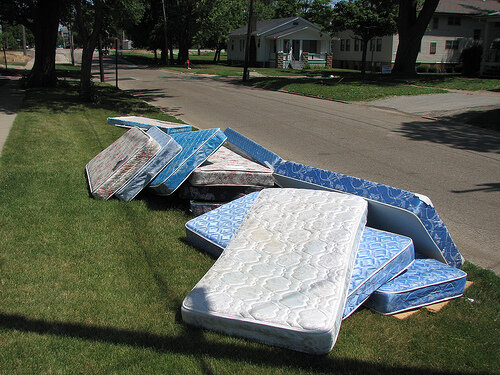
In Context: In 2013, the legislature enacted the Used Mattress Recycle and Revocery Act. The Mattress Recycling Council (MRC), with oversight from CalRecycle, is the stewardship organization tasked with implementing California’s mattress recycling program. As part of the program the MRC collects a consumer fee on each mattress sold (roughly 40 million in 2018) from California consumers, which is used to implelent the MRC’s recycling plan.
The MRC’s plan also requires the organization to increase the number of used mattresses diverted from landfills, reduce ilegall dumping of mattresses and increase the quantity of used materials recovered and recycled for other uses.
Bill Summary: Among other things, AB 187:
This bill makes various changes to the Used Mattress Recovery and Recycling Act in response to an audit report conducted by the Bureau of State Audits, as well as other changes to the program to enhance used mattress collection and recycling.
Senate Floor Amendments of 9/6/19 make a technical change to refer to calendar year instead of fiscal year in reference to the requirement that the mattress recycling organization maintain reserves not more than 60% of its annual operating expenses.
Supporters:
California Product Stewardship Council
California Refuse Recycling Council
Northern District California Resource Recovery Association
City of Torrance
Public Works Department County of Alameda
National Stewardship Action Council
Northern California Recycling Association
Rethink Waste
Rural County Representatives of California
StopWaste
SWANA
California Chapters Legislative Task Force
Western Placer Waste Management Authority
CAW Staff Contact: Tony Hackett, (916)443-5422
AB 614 (Eggman)—“Farm to Food Bank” Tax Credit
Overview: This bill would expand the list of eligible food items that may be donated to a Food Bank to include both fresh and processed foods to help increase access to food insecure Californians.
CAW Position: Sponsor
Status: Signed by Governor
In Context: In a 2017 study conducted by the US Department of Agriculture, researchers found that nearly fifteen million American households were food insecure, or had very low food security. While in California, it is estimated that over six million Californians, including one in every four children, are food insecure.

Nearly 1 million Californians, both urban and rural, live in food deserts and spend an inordinate amount of time and money simply trying to find healthful food for their families. Food banks often provide relief for these food insecure families who do not have access to fresh and healthy foods.
While current law allows agricultural growers to receive a state tax credit for donating surplus produce, the categories of eligible items that may be donated are limited to fresh fruits and vegetables. Many food items that most households would consider to be staples—such as infant formula, nuts, rice, meat, and dairy—are excluded from this list.
Bill Summary: AB 614 would increase access to the food donation tax credit for agricultural growers by expanding the list of qualified donation items to food banks and other non-profit organizations by including other fresh food items not currently in statute, as well as various shelf-stable dietary staples.
Supporters:
Californians Against Waste (co-sponsor)
California Association of Food Banks (co-sponsor)
California Food Producers
Dignity Health Kings Community Action Organization
Sacramento Food Bank and Family Services
CAW Staff Contact: Erica Parker, (916)443-5422
AB 619 (Chiu)—Bring-Your-Own Reusable Food and Beverage Containers
Overview: AB 619 expands consumer choice, helps local businesses, and advances California’s longstanding goal to reduce landfill waste and plastic pollution by increasing access to reusable food ware at events and in restaurants.
CAW Position: Support
Status: Signed by Governor
Source: The Flexitarian
In Context: The CalCode, which governs retail food facilities, is based on the model food code published by the U.S. Food and Drug Administration (FDA), although there are some differences. With regard to refilling returnable containers, the FDA model food code requires empty containers returned to a food facility for cleaning and refilling to be cleaned and refilled in a food processing plant – not a retail food facility – unless it meets certain exceptions to be able to be refilled at the food facility. These exceptions include when the take-home food container is designed and constructed for reuse in accordance with specified requirements, and was initially provided by the food establishment to the consumer for the purpose of being returned for reuse. The revisions this bill is making to the CalCode, in general, conform more closely to the federal model code, by referencing the design standards for containers intended for reuse.
Bill Summary: Among other things, AB 619 will:
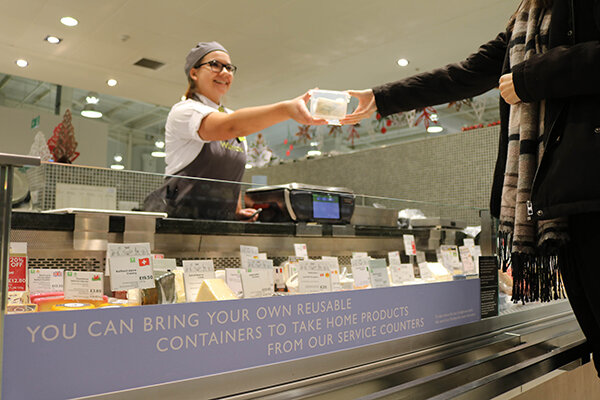
AB 619 would end the requirement that temporary food facilities at community events provide single-use foodware by allowing – but not mandating – vendors at street festivals, county fairs, outdoor concerts, and other community events to serve food and beverages in washable cups, dishes, and utensils.
AB 619 would also make clear for restaurants that they may serve food and beverages in consumer-provided reusable containers.
This simple fix would give food facility operators the flexibility to respond to consumer preferences, save money, and protect the environment, while creating marketing opportunities for businesses that want to “go green” at popular community events. Additionally, it would provide consumers with clear, safe conditions for using their own food and beverage containers at all retail food facilities.
Supporters: For full list of supporters, see the Senate analysis here.
CAW Staff Contact: Tony Hackett, (916)443-5422
AB 729 (Chu)—Carpet Recycling
Overview: This bill revises the Product Stewardship for Carpets Program increase accountability and accomplish the state’s mattress recycling goals.
CAW Position: Support
Status: Signed by Governor
In Context: According to the author, “California has led the way with its flagship carpet recycling program. My bill from 2017, AB 1158, outlined specific targets and gave the State the authority to set future targets for carpet recycling. However, the State needs additional tools to provide a backstop in the case a plan is inadequate to meet set recycling goals. Currently, there is no mechanism to continue the program if a stewardship plan submitted by manufacturers is disapproved, AB 729 will allow for a “bridge” plan to avoid disruptions in our carpet recycling infrastructure and protect consumer fees if a plan is disapproved or revoked.”
This bill is intended to address a shortcoming that has been identified in the state’s product stewardship programs – what happens to the fee money collected from consumers if the organization is unable to continue program operations, either through an enforcement action by CalRecycle or if the organization is dissolved or unwilling to continue operations. Particularly, given the complex enforcement history in this program, it is important that the state has a mechanism to oversee funds if CalRecycle does not grant additional extensions to CARE after the current September 1st deadline to preserve California’s carpet recycling infrastructure and protect California consumers.
Under AB 729, if a plan is terminated or revoked and CalRecycle does not approve a new carpet stewardship plan within one year, CalRecycle would be authorized to modify the previously approved plan and take over the program.
Bill Summary: Among other things, AB 729:
Require a carpet stewardship organization to include in the carpet stewardship plan a contingency plan should the carpet stewardship plan expire without approval of a new carpet stewardship plan or should the carpet stewardship plan be revoked. The bill would require a carpet stewardship organization to set up a trust fund or an escrow account, into which the bill would require the organization to deposit all unexpended funds and ongoing consumer assessments, for use in the event that the carpet stewardship plan terminates or is revoked. The bill would require, if a carpet stewardship plan is revoked or terminated, the trustee or escrow agent to accept carpet stewardship assessment payments directly from manufacturers and to make payments from the trust fund or escrow account as the department directs, in writing, to implement the most recently approved carpet stewardship plan. The bill would authorize the department, if a new carpet stewardship plan has not been approved within one year after termination or revocation, to make modifications to the previously approved plan, as it deems necessary, and continue to direct payments from the trust fund or escrow account to implement the modified plan.
Repeal certain provisions relating to the carpet stewardship assessment and would replace the assessment with differential assessments that take into account the financial burden that a particular carpet material has on the stewardship program, and the amount of postconsumer recycled content contained in a particular carpet, as prescribed.
Increase the administrative penalties from $1,000 per day to $5,000 per day.
Supporters:
National Stewardship Action Council (Sponsor)
Californians Against Waste
CAW Staff Contact: Tony Hackett, (916)443-5422
AB 792 (Ting) – Minimum Recycled Content
Overview: This bill would establish a time frame for minimum recycled content for plastic bottle beverage manufacturers follows:
January 1, 2021 – 10% minimum content
January 1, 2025 – 25% minimum content
January 1, 2030 – 50% minimum content
AB 792 would also set penalties for manufactures that do not meet the requirements, with the penalties increasing as the recycled content decreases.
CAW Position: Support
Status: Vetoed by Governor
“While I support strong minimum content standards, late amendments to this bill would result in costly, burdensome process that undermines the worthy intent of this legislation… I look forward to working with the legislature and stakeholders to accomplish our shared goals.”
-Gov. Gavin Newsom
Click here to read the Governors full veto message.
In Context: : In California alone, nearly 12 billion plastic bottles are sold every year. While many plastic bottles are made of recyclable content, more than 3 billion bottles are not recycled at all, and are dumped in landfills. In order to encourage efficient use of recyclable plastics, this bill sets a minimum recycled content standard in California.
According to the California Department of Resources Recycling and Recovery (CalRecycle), California exports nearly one third of its recycled material to other countries every year. However, in 2018, China established their National Sword policy, which bans the import of recycled mixed paper and certain types of recycled plastic and imposes a stringent 0.5% contamination limit on all other recycled material imports. A significant portion of recycled plastics were shipped overseas until China established their National Sword policy. Now, California is facing an increasing crisis of recycled plastic stacking up in warehouses or going to landfills.
California has established minimum recycled content requirements for glass containers, rigid plastic packaging containers, newsprint, trash bags, and other products. However, California does not require the use of recycled content in plastic containers regulated under the California Beverage Container Recycling and Litter Reduction Act.
Many companies have already taken the initiative at closing the loop by using plastic bottles that contain 100% recycled content. Since November 2010, Naked Juice Company has been using bottles made with 100% post-consumer recycled content for all of its juices and juice smoothies. In January 2018, Evian’s manufacturer announced that it will make all its bottles from 100% recycled plastic by 2025.
Additionally, manufacturers have made commitments to use more recycled content. Nestle Waters North America announced in 2018 that they will use 25% recycled content for plastic packaging for their product line by 2021, and has a goal of 50% by 2025. In 2018, Coca-Cola announced their goal of using 50% recycled content in all of their packaging by 2030. However, Coca-Cola in United Kingdom will use 50% recycled content in their plastic bottles by 2020, and 50% recycled content by 2025 in the European Union.
Supporters: For a full list of supporters please see the Senate Analysis here.
CAW Staff Contact: Mark Murray (916)443-5422
AB 827 (McCarty)—Customer Access to Recycling
Overview: Requires businesses to make composting and recycling bins accessible to customers at restaurants, malls, and other businesses.
CAW Position: Sponsor
Status: Signed by Governor
In Context: A combination of SB 1383’s 75% organic waste diversion goal and China’s National Sword policy has created an environment where both business and environmental advocates must work together to find comprehensive and long term solutions.

In Context: For three decades, CalRecycle has been tasked with reducing disposal of municipal solid waste and promoting recycling in California through the IWMA. Under IWMA, the state has established a statewide 75 percent source reduction, recycling, and composting goal by 2020 and over the years the Legislature has enacted various laws relating to increasing the amount of waste that is diverted from landfills. According to CalRecycle’s State of Disposal and Recycling in California 2017 Update, 42.7 million tons of material were disposed into landfills in 2016.
Summary: This bill Requires commercial waste generators and organic waste generators that provide customers access to the business to provide customers, by July 1, 2020, with a commercial solid waste recycling bin or an organic waste recycling bin to collect materials purchased on the premises. This bill also requires the Department of Resources Recycling and Recovery (CalRecycle) to develop model signage that the businesses may utilize in implementing these requirements.
Supporters:
Californians Against Waste (Sponsor)
Association of Compost Producers
Los Angeles County Solid Waste Management Committee/Integrated Waste Management Task Force
Recology
RecycleSmart
Republic Services, Inc.
RethinkWaste
CAW Staff Contact: Tony Hackett, (916)443-5422
AB 1162 (Kalra)—Single Use Hotel Toiletries
Overview: Prohibits a lodging establishment from providing a small plastic bottle containing shampoo, hair conditioner, or bath soap to guests, as specified, and makes the lodging establishment civilly liable upon violation.

CAW Position: Sponsor
Status: Signed by Governor
In Context: According to the Wall Street Journal, "billions of half-full bottles get thrown away every year. Think of it as roughly 1,000 bottles for every hotel room, multiplied by more than 5 million hotel rooms in the [United States]” The American Hotel and Lodging Association states there are currently 515,285 hotel rooms in California. This figure does not include smaller establishments, so the total is likely substantially higher. Hotels have begun to take action to reduce their impact. Last year, Marriott announced plans to install bulk dispensers in 450 properties, including high-end facilities like the Ritz-Carlton spas. Marriott estimates those 450 properties will reduce the number of plastic bottles distributed by 10.3 million, or 113,000 pounds of plastic.
This bill is very similar to an ordinance in Santa Cruz that will take effect December 31, 2020. The ordinance will prohibit hotels and other lodging establishments from providing small plastic bottles of personal care products in its effort to address the growing problem of plastic debris and to protect public health and the environment.
Bill Summary: Among other things, AB 1583:
Prohibits a lodging establishment from providing a small plastic bottle containing shampoo, hair conditioner, or bath soap to guests, as specified, and makes the lodging establishment civilly liable upon violation.
Final Amendments:
Increase the size of containers covered by the bill from three ounces to six ounces.
Require consideration of health and safety when encouraging the use of bulk containers.
Remove the requirement that specified local agencies take all reasonable efforts to notify affected lodging establishments of the bill’s requirements.
Supporters:
5 Gyres Institute
California Hotel & Lodging Association
Center for Oceanic Awareness, Research, and Education
Heal the Bay Nature
Resources Defense Council
Plastic Pollution Coalition
RethinkWaste
Save Our Shores
Seventh Generation Advisors
StopWaste
Surfrider Foundation
The Story of Stuff Project
UPSTREAM
Wishtoyo Chumash Foundation
Zero Waste USA
CAW Staff Contact: Tony Hackett, (916)443-5422
AB 1163 (Eggman)—Right to Repair
Overview: This bill establishes the California Recycling Market Development Act which seeks to update and revise gaps in existing California recycling policy, and seeks to balance California’s ambitious environmental goals with changing market realities.
CAW Position: Sponsor
Status: Active in Assembly Privacy and Consumer Protections Committee

In Context: For 30 years, California has required that manufacturers making an express warranty provide access to replacement parts and service materials for electronics and appliances to the manufacturer’s authorized repairers in the state. This bill extends this requirement to also provide the same parts and service materials, under fair and reasonable terms, to independent service dealers regulated by the Department of Consumer Affairs and to individual owners. This will create a more competitive repair marketplace ensuring that consumers aren’t forced to pay a manufacturer’s designated, high cost repair service, or be forced to invest in a new item altogether due to their inability to affordably repair broken electronics and appliances
Bill Summary: Among other things, AB 1583:
Reauthorizes AB 199 (Eggman) Recycling Sales Tax Exemption, which sunsets in 2020.
Reauthorizes the Recycling Market Development Zone (RMDZ) Program, which sunsets in 2020
Establishes a “Statewide Commission on Recycling Markets and Curbside Recycling” of private and public curbside recycling operators to identify uniform product design suggestions to facilitate compatibility with MRF’s and end markets, and to advise CalRecycle on the recyclability of products and packaging
Eliminates the requirement to have “chasing arrows” around Resin ID Codes (RIC), thereby reducing consumer confusion about what is recyclable.
Supporters:
Californians Against Waste (co-sponsor)
CALPIRG (Co-Sponsor)
Consumer Reports (Sponsor)
The Electronic Frontier Foundation (Sponsor)
iFixIt
CAW Staff Contact: Tony Hackett, (916)443-5422
AB 1509 (Mullin, Berman)—Lithium-Ion Batteries
Overview: AB 1509 would create a recycling program for both loose Li-ion batteries and ones embedded in products to prevent them from being improperly disposed of in the waste stream. Segregating them from our waste stream will significantly reduce the fire and safety risks these batteries impose.
CAW Position: Sponsor
Status: Senate Environmental Quality Committee
In Context: : Li-ion batteries are lightweight, rechargeable batteries that store high levels of energy in relation to their size. Their high energy density allows them to power portable electronic devices, such as cell phones, tablets, laptops, and power tools.
When improperly disposed of, these batteries pose a serious fire, health, and safety hazard. As the increased rate of consumption has led to higher levels of batteries that end up in the waste stream, an alarming number of fires have resulted at our material recovery facilities (MRFs), transfer stations, waste collection trucks, and landfills.
These fires cause immense damage to cities’ and counties’ waste collection and processing vehicles, equipment, and facilities while also endangering the lives of their workers
Summary: Establishes the Lithium-Ion Battery Recycling Program within the California Department of Resources, Recycling, and Recovery (CalRecycle) that requires manufacturers of lithium-ion batteries to provide convenient collection, transportation, and disposal of lithium-ion batteries.
Supporters:
Californians Against Waste (Co-Sponsor)
Rethink Waste (Co-Sponsor)
California Product Stewardship Council (Co-Sponsor)
CAW Staff Contact: Tony Hackett, (916)443-5422
AB 1583 (Eggman) — The California Recycling Market Development Act
Overview: This bill establishes the California Recycling Market Development Act which seeks to update and revise gaps in existing California recycling policy, and seeks to balance California’s ambitious environmental goals with changing market realities.
CAW Position: Sponsor
Status: Signed by Governor
In Context: A combination of SB 1383’s 75% organic waste diversion goal and China’s National Sword policy has created an environment where both business and environmental advocates must work together to find comprehensive and long term solutions.

Bill Summary: Among other things, AB 1583:
Reauthorizes AB 199 (Eggman) Recycling Sales Tax Exemption, which sunsets in 2020.
Reauthorizes the Recycling Market Development Zone (RMDZ) Program, which sunsets in 2020
Establishes a “Statewide Commission on Recycling Markets and Curbside Recycling” of private and public curbside recycling operators to identify uniform product design suggestions to facilitate compatibility with MRF’s and end markets, and to advise CalRecycle on the recyclability of products and packaging
Eliminates the requirement to have “chasing arrows” around Resin ID Codes (RIC), thereby reducing consumer confusion about what is recyclable.
Supporters:
Californians Against Waste (co-sponsor)
Republic Services (co-sponsor)
California State Association of Counties
Coalition for Renewable Natural Gas
Rural County Representatives of California
City of Huntington Beach
CAW Staff Contact: Nick Lapis (916)443-5422
AB 1672 (Bloom)—Flushable Products
Overview: This bill establishes criteria for "flushability" for nonwoven disposable products and requires non-flushable labels on nonwoven disposable products that do not meet those flushable criteria.
CAW Position: Support
Status: Active in Assembly Appropriations Committee
In Context: When wet wipes products are flushed into the sewer system they can cause significant issues for private property owners, sewer collection systems, and wastewater treatment plants. Wet products that do not break down can catch on tree roots or other obstructions in residential sewer laterals and cause costly and dangerous backups for property owners. Wet wipes have been shown to cause significant damage to residential septic systems, resulting in expensive repairs and remediation for homeowners.
Bill Summary: AB 1672 presents a straightforward solution to helping combat the aforementioned problems caused by improperly flushing wet wipes. The bill prescribes clear and consistent consumer messaging for these products that indicates to consumers that either a wipe is 'flushable,' or it is not. Under the provisions of AB 1672, wipes can be labeled as 'flushable' if they do not cause harm to the sewer system, meaning that manufacturers can demonstrate that their wipes break down in the sewer system like dry toilet paper. For all other wipes that are not intended to be flushed, they must be conspicuously marked with 'Do Not Flush' labeling.
Supporters: For a full list of supporters, see the Assembly Environmental Safety Committee analysis here.
CAW Staff Contact: Tony Hackett, (916)443-5422
SB 8 (Glazer) / AB 1718 (Levine)—Smoking ban for State Parks and Beaches
Overview: The purpose of this bill is to help address public health concerns and environmental impacts associated with smoking, including litter, toxins in cigarette butts ingested by wildlife, wildfires, and plastic litter from disposable liquid cartridges of e-cigarettes. State Parks currently prohibits smoking in state park buildings, on trails, on specific guided walks and during high fire seasons. The state park system includes 300 miles of state beaches and 280 state park units covering a total of 1.3 million acres.
CAW Position: Sponsor
Status: AB 8 was signed by Governor. AB 1718 was vetoed by Governor.
Bill Summary: These bills:
Prohibit a person from smoking on a state coastal beach or in a unit of the state park system. The prohibition applies to cigars or cigarettes containing tobacco or any other weed or plant used as an alternative or supplement to tobacco or nicotine, and also includes electronic and vapor cigarettes. Exempts props used for filming and the use of tobacco products for the good-faith practice of religious belief or ceremony. Exempts parking lots and roadways from the smoking prohibition.
Prohibits a person from disposing of used cigar or cigarette waste on a state beach or in a state park unit.
Requires the Department of Parks and Recreation (State Parks), or any local operating entity, to post signs providing notice of the smoking prohibition. Provides that the smoking prohibition will be enforced only after signs have been posted.
Allows the director of State Parks to exempt areas within units of the park system from the smoking prohibition after considering public health and safety and potential fire risk.
Makes a violation of this bill an infraction, punishable by a fine of up to $25.
Supporters: For full list of supporters, see the Senate analysis here.
CAW Staff Contact: Tony Hackett, (916)443-5422
SB 54 and AB 1080 (Allen and Gonzalez) The California Circular Economy and Plastic Pollution Reduction Act
Overview: SB 54 and AB 1080 will ensure California is on the forefront of reducing pollution from plastic packaging and single-use products. The bills would set goals to reduce waste from these items at the source, as well as through recycling and composting, and would establish a framework to address plastic pollution and waste.
Sacramento Bee: Recycling Won't Save Us. Let's Phase Out The Scourge Of Plastic Pollution
The Problem:
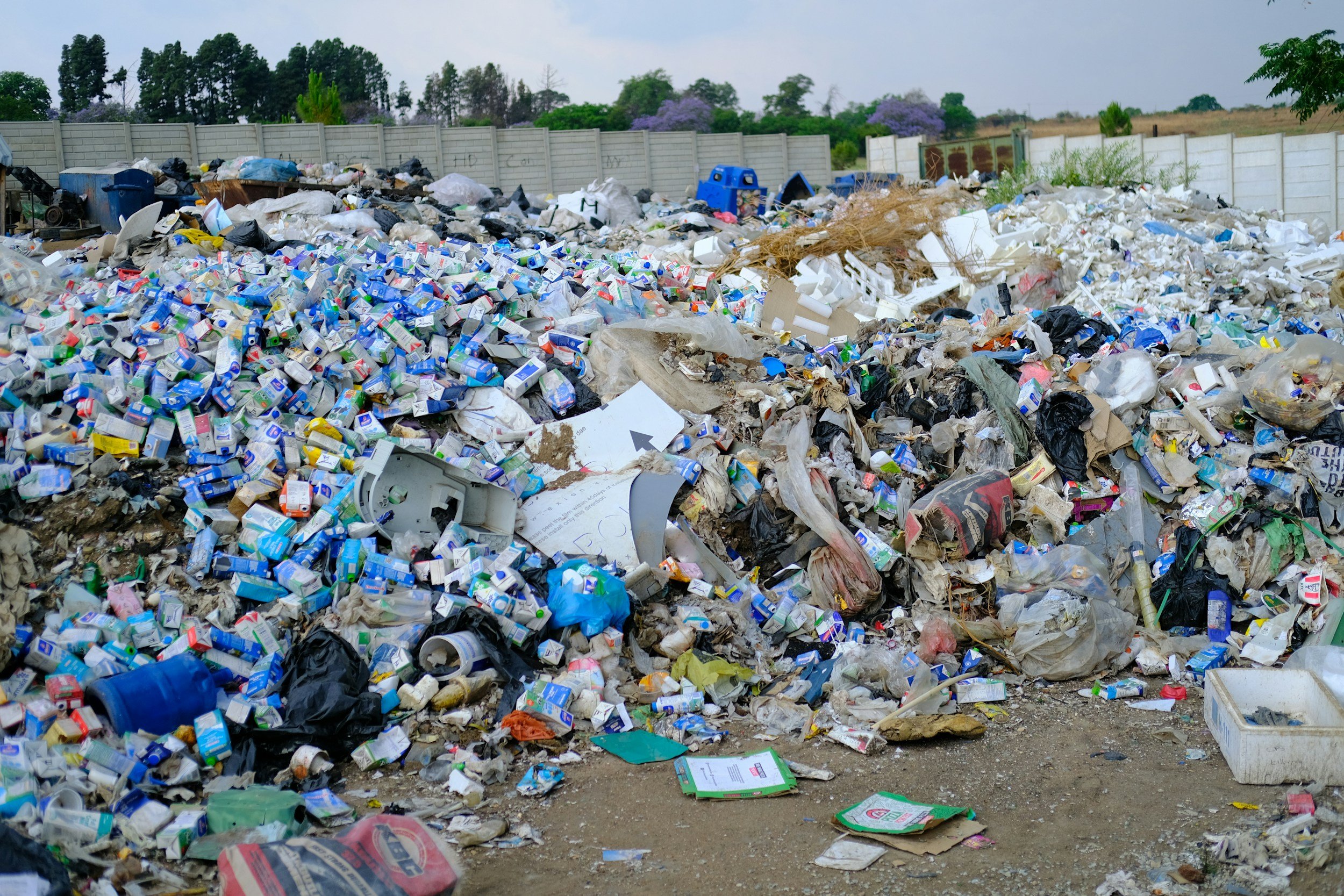
With a planned 40-percent increase in plastic production over the next decade, plastic production will account for 20 percent of global fossil fuel consumption unless we make major policy changes to counter.
Less than 9 percent of plastic is recycled, and that percentage is dropping since the implementation of China’s National Sword and policies in other countries, which severely restricted the amount of foreign waste these countries accept.
While the state and local communities in California have tried to reduce the burden from single-use packaging since the 1980s, taxpayers and local governments still spend over $420 million annually in ongoing efforts to clean up and prevent litter in streets, storm drains, parks and waterways.
Packaging products are typically designed to be used just once and then discarded and they account for 42 percent of all non-fiber plastic produced.
Bill Summary: Eliminating non-reusable, non-recyclable and non-compostable plastic single-use products and packaging is by far the most effective, and least expensive way to protect the health of people, wildlife, and the environment. Many reliable and reusable alternatives already exist, and the positive results of their use have been proven. SB 54 and AB 1080 would:
Require producers to design plastic packaging to reduce unnecessary waste and be fully recyclable or compostable by 2032.
Require that priority single-use plastic food service ware products, including plates, bowls, cups, utensils, stirrers, and straws be source reduced, and manufactured with only recyclable or compostable material by 2032.
Require CalRecycle to develop regulations to guide producers in complying with these requirements, and to establish incentives and policies to encourage in-state manufacturing using recycled material generated in California.
Position & Status: CAW supports the bills.
CAW Staff Contact: Mark Murray, Nick Lapis (916) 443-5422
SB 424 (Jackson)—Tobacco Waste Reduction and EPR
Overview: This bill prohibits a person or entity from selling, giving, or in any way furnishing to another person of any age in the state any single-use filters, plastic devices, electronic cigarettes, and vaporizer devices, as specified. Requires the manufacturer of these components to use materials eligible for recycling under state or local recycling programs to make any multiuse, reusable component, and to offer methods for recycling those components, as specified.
CAW Position: Support
Status: Active in Assembly Governmental Organization Committee

In Context: According to the author, tobacco product waste is a pervasive problem that has reached a crisis point. Single use filters, otherwise known as ‘cigarette butts’, can be found in every corner of this state, including our beaches, parks, coasts, and waters. Cigarette butts are the number one type of litter found in public clean-ups. Other tobacco product litter is increasingly found across the state. Tobacco product waste not only impacts the environment as other waste, like plastics, the tobacco-related component of that waste additionally pollutes toxic chemicals that adversely impairs ecosystems and kills wildlife. Tobacco product litter can be accidentally consumed by pets and small children, resulting in toxic harms. Municipalities spend millions on the clean-up of tobacco product waste, and, increasingly, millions more when waterways are rendered out of compliance with water quality laws because of tobacco waste pollution. Without a comprehensive program to bring manufacturer responsibility and recyclability standards into the equation, the public taxpayer will continue to pay for improper disposal of these products.
While this bill is primarily focused on the environmental impact of wasteful single-use tobacco product components and not on the increase in youth use, research by Committee staff indicates that often single-use components, such as single-use vape pens, are cheaper than rechargeable, multiuse devices. While there is no data available on youth use of single-use vape pens specifically, the proliferation of youth use of ESDs may also include use of single-use electronics cigarettes and vape pens.
Bill Summary: Among other things, SB 424:
Prohibits a person from selling, giving, or furnishing to another person certain single-use cigarette products. Requires manufacturers of tobacco products with a reusable component to either use recyclable materials to make any reusable component of the tobacco product or to collect the reusable components through a take-back or mail-back program either individually or through a stewardship program, as specified. Prducts covered under this bill include:
Cigarettes utilizing a single-use filter made of any material, including cellulose acetate, any other fibrous plastic material, or any organic or biodegradable material
Attachable and single-use plastic devices meant to facilitate manual manipulation or filtration of a tobacco product
Single-use electronic cigarettes
Single-use vaporizer devices
Supporters: For a full list of supporters, see the Senate analysis here.
CAW Staff Contact: Tony Hackett, (916)443-5422
SB 724 (Stern, Glazer)—Bottle Bill Buy-Back Centers
Overview: This bill would amend California’s Bottle Bill Program to provide temporary financial assistance to recycling centers while providing exemptions to dealers from various consumer redemption opportunities.
CAW Position: Support
Status: Dead - Held in Senate Appropriations Committee
In Context: California’s beverage container recycling infrastructure and consumers opportunity to recycle is in the midst of a three year crisis initiated by a global decline in scrap values but perpetuated by the failure of California program payments to keep pace and offset revenue loss.

The crisis has seen a closure of 38% of recycling centers—more than 127 cities and 2 counties have no operating centers, and hundreds of other communities are underserved. The closures have resulted in a 10% drop in recycling rates.
The crisis has underscored the fact that more than half of beverage containers generated in the state are consumed outside the home and, thus, not available to the curbside system. In addition to consumer redemption, the buyback network supports container recycling by school and church groups, litter clean-up efforts, non-profits and commercial collection. According to CalRecycle, just 10% of beverage container recycling occurs via curbside.
SB 724 is aimed at addressing this crisis by restoring support for the recycling infrastructure to 2015 levels, and providing CalRecycle with new incentives and authority returning recycling to unserved/underserved communities. This measure will help maximize beverage container recovery, expand consumer convenience, and ensure that every container generated has the opportunity to be recycled into a new product. To do so, the bill contains three key elements to stabilize the recycling marketplace:
Restore recycling incentives to the infrastructure (buy back, drop-off, collection and curbside) to 2015 level (reflective of statutory cost-of-living and the reasonable financial return adjustments);
Refocus CalRecycle resources on bringing recycling opportunities to unserved communities, while providing temporary relief to some dealers faced with take-back requirements at no fault of their own; and
Require CalRecycle to develop recommendations to the Legislature to ensure that program payments are adequate to maintain the state’s recycling infrastructure.
Bill Summary: Among other things, SB 724:
Exempts specified dealers that are located in specific recently unserved convenience zones from Bottle Bill redemption requirements until 2022.
Limits the number of exemptions for a convenience zones.
Requires, for purposes of calculating processing payments, CalRecycle to use the costs of recycling that were in effect on December 30, 2015, and to use a certain formula in calculating the reasonable financial return. Prohibits, until December 31, 2019, CalRecycle from imposing a processing fee on beverage manufacturers that is higher than what would be imposed under existing law.
Authorizes supplemental handling fee payments to low-volume recycling centers and recyclers willing to open a recycling center in a recently unserved convenience zone.
Supporters: For full list of supporters, see the Senate E.Q. analysis
CAW Staff Contact: Mark Murray, (916)443-5422
SB 726 (Caballero)—Household Hazardous Waste Reuse
Overview: This legislation seeks to reduce the unnecessary incineration and disposal of hazardous household waste products by empowering local jurisdictions to improve and expand their Household Hazardous Waste (HHW) reuse programs.
CAW Position: Support
Status: Signed by Governor
In Context: California’s Integrated Waste Management Act, AB 939 from 1989, addresses solid and HHW, setting the waste reduction hierarchy as Source Reduction First, then Recycling and Disposal. California’s intent is to encourage waste reduction and reuse while ensuring that waste is disposed of in the most environmentally responsible manner possible.
The proposed statutory changes simply update the Health and Safety Code to enable local HHW reuse programs to expand their operations beyond current efforts to hold materials on site for reuse by customers, which aligns with California law.
Based on a March 2015 CalRecycle Survey, only 46% of responding HHW Programs provide a reuse program in their jurisdiction. Unfortunately, as little as 3% of all household hazardous products collected annually is being reused, when roughly 15% are actually reusable.
Modern technology allows local jurisdictions and their contractors to scan HHW and make determinations about whether an item is reusable. Reusable items can then be diverted from landfill or incineration and reused by other consumers. This often benefits lower income households and the non-profits that serve them, such as Habitat for Humanity
Bill Summary: Among other things, AB 726:
Authorizes a public agency’s contractor to conduct that materials exchange program and would require that contractor to provide those same instructions to a recipient.
Authorizes the operation of a hazardous waste collection facility for the additional purpose of accepting reusable household hazardous products or materials and providing those products or materials to recipients.
Requires reusable household products or materials to be transported by those same entities and would additionally authorize a permanent household hazardous waste collection facility to transport hazardous waste or reusable household products or materials.
Prohibits an individual from transporting reusable household hazardous products or materials that exceed existing maximum volume and weight limits.
Additionally requires a recipient of a household hazardous product or material be responsible for using the product or material in conformance with its label, using appropriate personal protection, and managing unused products or materials as required by applicable state laws.
Supporters: For the full list of supporters, see the Senate analysis here.
CAW Staff Contact: Tony Hackett, (916)443-5422