California Just Banned Disposable Vapes. Here’s Why It Matters, and What Comes Next.
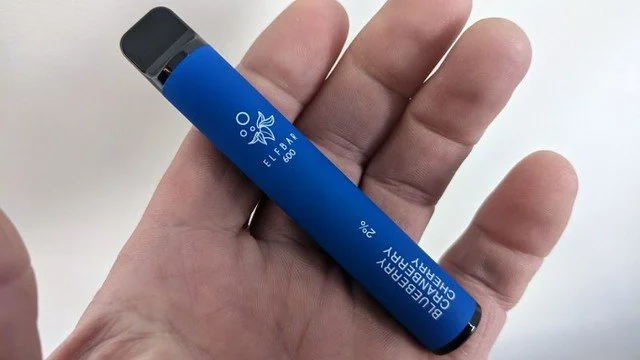
Image of a disposable nicotine vape. This image is released under Creative Commons and attributed to www.ecigclick.co.uk.
Governor Newsom signed AB 762 (Irwin) into law. Starting January 1, 2027, it will be illegal to sell non-rechargeable or non-refillable nicotine vapes in California. Californians Against Waste (CAW) co-sponsored this bill, and we’re proud of where it landed.
Why this matters for waste
Most of the public conversation about vapes is about flavors and teen addiction. Those are real problems. But AB 762 is also a waste bill, and that’s the angle CAW carried from day one.
Every disposable vape contains a lithium-ion battery, a circuit board, and a reservoir of nicotine salts. They’re used for a few days, maybe a couple of weeks, and then tossed. There is no recycling pathway for them. Tens of millions end up in household garbage and recycling bins, or littered on sidewalks and in storm drains, where they leach toxic chemicals and add to plastic pollution.
Then there are the fires; when lithium batteries get crushed in garbage trucks or at sorting facilities, they spark. Waste operators across the state have been dealing with a sharp rise in lithium battery fires, and disposable vapes are a leading cause. Every one of those fires puts sanitation workers, facilities, and surrounding communities at risk.
AB 762 targets a product that was engineered with no end-of-life plan. That was the core of our argument, and the opposition never had an answer for it.
How we got here
This was not easy. The disposable vape industry, backed by major tobacco interests, fought to gut the bill with weakening amendments and stall it in committee after committee. We pushed back at every step with fact sheets, fiscal analyses, hearing testimony, and coalition partners in key districts who made sure legislators heard from their own constituents.
We’re grateful to every coalition partner who showed up, especially the public health organizations and local advocates who did the district-level work that moved votes. The California Product Stewardship Council, a co-sponsor on the bill, honored CAW with its Bow and Arrow Award for coalition building on this campaign.
What comes next
A sales ban keeps new disposable vapes off shelves. It does nothing about the tens of millions of devices already sitting in people’s homes, drawers, and glove compartments. Those still need a safe way to be collected and handled, and that pathway doesn’t fully exist yet.
The real question is who pays. Our position hasn’t changed: the responsibility belongs with the producers who profited from making these products, not with taxpayers, local governments, or the sanitation workers dealing with the fallout. Disposable vapes need extended producer responsibility, and it’s the framework we’ll bring to whatever comes next.
There’s also the fire problem. As long as lithium batteries are circulating in the waste stream, the fire risk at collection and processing facilities remains. Safe collection points, clear public guidance on disposal, and actual recycling infrastructure all need to be built out. And cannabis vapes, which fall under a separate regulatory system, present their own version of the same problem. That’s still unresolved.
The bigger picture
When you treat a waste problem as a waste problem and follow the product from factory to landfill, you can build policy that holds up against even well-funded opposition. California has now made it clear that it won’t accept products designed to fail at the public’s expense.
For CAW members and supporters: this is what your involvement makes possible. We’ll keep you posted as the next chapter unfolds, because the story of disposable vapes in California is not over.