

2023 - 2024 LEGISLATIVE SESSION
CAW PRIORITY LEGISLATION
SIGNED BY THE GOVERNOR

SB 1053 (Blakespear & Bauer Kahan) amends current law to no longer allow specific stores to provide ‘thicker’ plastic bags at check stands as ‘reusable’ bags.

AB 660 (Irwin) requires food manufacturers to use uniform terminology when labeling their products with "safety" or "quality" dates, and bans the use of consumer-facing "sell-by" dates.

SB 244 (Eggman) requires manufacturers of consumer electronics to provide replacement parts, diagnostic information, and service literature to consumers and third-party repair businesses.

SB 353 (Dodd) expands California’s Bottle Bill to include juice containers 46 oz and larger and fixes a flaw in the payment formula that funds recycling centers.
NO LONGER MOVING

AB 891 (Irwin) would have established a non-binding policy goal to support the use non-petroleum materials in plastic beverage containers.

AB 1290 (L.Rivas) would have eliminated several of the most problematic forms of plastics that contaminate recycling or pose a risk to human health.

AB 1347 (Ting) would have required businesses to provide customers the choice between receipt or no receipt and prohibited the use of bisphenols in receipts.

AB 1534 (Irwin) would have required the CARB to incorporate remote sensing technologies into landfill regulations.

AB 1705 (McKinnor) would have instituted a moratorium on the establishment and expansion of transformation and EMSW facilities until specific recycling and organic waste goals have been met for three consecutive years.


AB 2577 (Irwin) would have directed CalRecycle to regulate expiration date labels under SB 1383.
AB 2761 (Hart) would prohibit toxic polyvinyl chloride (PVC) and PFAS in plastic packaging which harm human health.
SB 552 (Newman) would have required restaurants to provide reusable foodware for on-site dining.
SB 1167 (Blakespear) would have required large chain restaurants to serve beverages in reusable cups for dine-in customers.


OTHER WASTE & RECYCLING LEGISLATION
SIGNED BY THE GOVERNOR
AB 421 (Bryan) — State Referendum and Ballot Initiative Reform
Makes changes to the state referendum and ballot reform processes to clarify what voting yes or no on a measure entails, among other changes.
AB 590 (Hart) — Advanced Payments for State Grants & Contracts for Nonprofits
Allows for advanced payments for state grants & contracts for nonprofits to proceed more quickly with approved projects given minimum requirements are met.
AB 863 (Aguiar-Curry) — Changes to California Carpet Recycling Program
Makes changes to the CARE carpet recycling program, including increasing fines, adding CA stakeholders to the CARE board, setting a closed loop recycling target and allocating 8% of the funds collected for workplace apprenticeship programs, among other changes.
Sponsored by National Stewardship Action Council
AB 1059 (Friedman) — Ban on Fiberglass in Mattresses & Furniture
Prohibits the sale or distribution of new mattresses and furniture containing fiberglass after January 1, 2027.
Sponsored by Environmental Working Group
AB 1526 (Assembly Natural Resources Committee) — Expanding PaintCare program
Expands existing PaintCare extended producer responsibility program to include aerosols among other changes.
AB 1548 (Hart) — Expanding Eligibility for CalRecycle Grants and Loans
Expands eligibility for CalRecycle’s existing grant & loan program for organics recycling, reuse, and other material recovery projects.
Sponsored by Rural County Representatives of California
AB 2346 (Lee) — SB 1383 Procurement Assistance for Local Governments
Provides additional tools and pathways for local jurisdictions to meet their SB 1383 procurement requirements, including through the use of individual/regional procurement targets tied to waste characterization data and the addition of edible food recovery and community compost, among other changes.
Sponsored by StopWaste
AB 2511 (Berman) — Extension of the PMD Program
Extends the sunset for the Plastic Market Development Program that was set to expire.
AB 2902 (Wood) — Implementing SB 1383 for rural jurisdictions
Addresses rural jurisdictions’ issues with implementation of SB 1383, including extending existing rural waivers, allowing some alternate compliance strategies for low-population jurisdictions, among other changes.
Sponsored by Rural County Representatives of California
SB 253 (Wiener) — Climate Corporate Accountability Act
Requires all U.S.-based companies that make over $1 billion in annual revenue to publicly report all their greenhouse gas emissions, including their direct, indirect, and supply-chain emissions.
Sponsored by California EnviroVoters, Carbon Accountable/Sunrise Movement Bay Area
SB 261 (Stern) — Climate Financial Risk Disclosure
Requires corporations and financial institutions with at least $500 million in revenues to annually disclose their climate-related financial risk, beginning in 2026.
SB 568 (Newman) — Exporting Electronic Waste
Prohibits exports of e-waste unless there is no capacity to recycle in California.
Sponsored by Camston Wrather
SB 613 (Seyarto) — SB 1383 Low Population Exemption
Extends the timeline for applying for a low population exemption under SB 1383.
SB 707 (Newman) — Responsible Textile Recovery Act of 2024
Mandates the formation of a Producer Responsibility Organization that manages the collection, transportation, sorting, and repair of textiles and apparel.
Sponsored by California Product Stewardship Council
SB 1143 (Allen) — Paint Extended Producer Responsibility
Expands the existing PaintCare Program to include additional paint products.
Sponsored by National Stewardship Action Council
SB 1147 (Portantino) — Microplastics in Drinking Water
Requires OEHHA to study and establish a Public Health Goal for microplastics in drinking water.
SB 1280 (Laird) – Refillable Propane Cylinders
Prohibits the sale of propane cylinders unless they are reusable or refillable by January 1, 2028.
Sponsored by California Product Stewardship Council
VETOED BY THE GOVERNOR
AB 246 (Papan) — PFAS in Menstrual Products
Would have prohibited the sale of menstrual products containing PFAS.
Read veto message from the Governor
AB 249 (Holden) — Lead Testing in Schools
Would have required community water systems that serve schools to test for lead.
Sponsored by Environmental Working Group
Read veto message from the Governor
AB 407 (Chen) — Used Oil Recycling
Would have provided an alternate management pathway for used oil to be recycled.
Read veto message from the Governor
AB 457 (Aguiar-Curry) - Wine & Distilled Spirit CRV Reduction
Would have lowered the CRV on wine and distilled spirits in containers under 24 ounces from 15 cents to 10 cents per container.
Read veto message from the Governor
AB 552 (Bennett) — Farmer Equipment Sharing
Would have required the Department of Food & Agriculture to develop a pilot program to support regional farm equipment sharing
Read veto message from the Governor
AB 1489 (Wood) — Exempting Compostable Plastics from SB 54
Would have exempted compostable plastics from SB 54 source reduction requirements
Read veto message from the Governor
AB 1628 (McKinnor) — Microfiber Filtration for Washing Machines
Would have required washing machine filters on new washing machines sold in California after January 1, 2029.
Sponsored by 5 Gyres, The Nature Conservancy & Ocean Conservancy
Read veto message from the Governor
SB 271 (Dodd) — Wheelchair Right to Repair
Would have required manufacturers of powered wheelchairs to provide parts, instructions and tools to authorized repair providers and users in order to complete repairs.
Read veto message from the Governor
SB 303 (Allen) — SB 54 Cleanup
Would have made clarifying changes to SB 54 (Allen).
Read veto message from the Governor
SB 615 (Allen & Min) — Electric Vehicle Batteries
Would have established requirements for reporting and end-of-life management requirements for EV batteries.
Read veto message from the Governor
SB 665 (Allen) — SB 54 Novel Plastics Working Group
Would have required CalEPA to develop framework for a working group to evaluate novel plastic and plastic alternatives as the state works to implement SB 54.
Read veto message from the Governor
SB 728 (Limon) — Ban on Plastic Gift Cards
Would have prohibited the sale of gift cards made of PVC plastic after January 1, 2027.
Read veto message from the Governor
SB 777 (Allen) — Plastic bag reporting requirements
Would have required stores covered by the statewide bag ban to report on sales of recycled paper and reusable bags.
Sponsored by United Food & Commercial Workers
Read veto message from the Governor
SB 972 (Min) — SB 1383 Assistance for Local Jurisdictions
Would have bolstered CalRecycle’s local assistance for jurisdictions in the implementation of organic food waste diversion programs under SB 1383.
Sponsored by CalCities
Read veto message from the Governor
SB 1066 (Blakespear) — Marine Flare Extended Producer Responsibility
Would have mandated the establishment of a manufacturer responsibility program and plan for marine flares
Sponsored by National Stewardship Action Council
2023 - 2024 LEGISLATION
AB 660 (Irwin)
OVERVIEW:
AB 660 requires food manufacturers to use uniform terminology when labeling their products with "safety" or "quality" date and bans the use of consumer-facing "sell-by" dates.
WHY SIMPLIFY DATE LABELS?

There are more than 50 differently phrased date labels used in the U.S. today, such as “Sell By,” “Expires On,” “Freshest Before,” “Please Enjoy By,” etc. Each of these phrases can be used to communicate different things by different brands, while some date labels contain no phrase next to them at all. The result is a confusing data labeling system and a staggering amount of food waste.
Research shows that 20% of all avoidable food waste is caused by consumer confusion over expiration dates, and streamlining these dates will reduce food waste, financial losses to consumers, and methane emissions from food rotting in landfills.
THE IMPACTS OF FOOD WASTE:
The environmental cost of food waste is undeniable. Food is the single most common material landfilled in California, and decomposing food and other organic waste in landfills accounts for 41% of the state’s point-source methane emissions. Methane is a potent greenhouse gas responsible for about 30% of the global warming that is now driving climate change.
Californians toss nearly 6 million tons of food waste each year and confusion over date labels is a leading cause. Food systems inherently depend on natural resources, such as water, land, minerals, and fuel. As such, food systems directly impact our environment, and wasted food is fundamentally a squandering of the natural resources used to grow, process, distribute, and store our food.
Wasted food also has significant impacts on food security in California. A survey referenced in, The Dating Game: How Confusing Food Date Labels Lead to Food Waste in America found that 91% of consumers reported that they at least occasionally discarded food past its “sell by” date out of concern for food safety, and 25% reported always doing so. “Sell by” dates inform retailers’ stock rotation rather than inherent food quality or safety.
Food banks and food pantries often receive packaged foods that have passed their “sell by” dates and have found that customers feel they are being offered spoiled food and may reject it. This keeps edible food from hungry citizens when 1 in 5 Californians currently struggle with food insecurity.
Reducing food waste is especially critical considering the cost to households – the average American spends over $1,300 a year on food that is never eaten. Tossing food prematurely because of misleading date labels costs Californians billions each year. In a time of rising grocery bills and food insecurity, every bit of savings helps.
Preventing food waste is essential to slowing climate change, promoting resource conservation, increasing food security, and saving Californians money.

Press conference for Assembly Bill 660 at the California State Capitol, August 26, 2024.
From left to right: Aakash Vashee (Office of Asm. Jacqui Irwin), Darryl Little Jr. (NRDC), Brett Williams (Office of Asm. Jacqui Irwin), Assemblymember Jacqui Irwin (D-Thousand Oaks), Erica Parker (CAW), and Nick Lapis (CAW).
Position: Co-sponsored by Californians Against Waste & Natural Resources Defense Council
Contact: Nick Lapis & Erica Parker
Status: Signed by Governor Newsom
Current language, analysis, and votes: AB 660
See related legislation: AB 2577 (Irwin) Regulating Expiration Dates
WHAT DOES AB 660 DO?

AB 660 defines a standard for producer- and consumer-facing labels on packaged foods.
This bill requires manufacturers distributing non-exempt products in California to use the same format for quality and safety dates. AB 660 also prohibits consumer-facing “Sell By” dates and alternatively allows coded “Sell By” dates. Coded “Sell By” dates retain stock rotation information for retailers while eliminating the source of consumer confusion that results in the disposal of wholesome, nutritious food.
-
This bill goes into effect July 1, 2026.
A sell-through period is permitted, allowing manufacturers and retailers to “sell through” remaining products which were manufactured before July 1, 2026, that may not be labeled in accordance with the new requirements. -
No. AB 660 does not require that manufactures and food producers add quality and/or safety dates on food items. The bill only requires (unless otherwise exempt) that any manufacturer/producer that decides to provide a date on the package must follow these rules:
1. There must be a phrase to accompany the date, and
2. The phrase must follow the approved formats for quality and safety dates accordingly. -
With the exception of baby formula, there are no federal regulations on food date labeling. Some states have regulated what food items need to have dates on them, but do not regulate what phrases (if any) are required to accompany those dates.
While this bill only applies to products sold in California, we are hopeful that AB 660 will serve as a catalyst for the enactment of similar legislation in other states. We are also hopeful that AB 660 will accelerate enactment of the Federal Food Date Labeling Act which similarly aims to clear up food date label confusion and reduce food waste.
AB 891 (Irwin)
OVERVIEW:
AB 891 will establish a non-binding policy goal to support the use of non-petroleum materials in plastic beverage containers.
THE ISSUE:
The plastic manufacturing process is heavily reliant on the oil and natural gas market. This links recyclable plastic to the volatile oil and natural gas market, making the state’s recycling infrastructure subject to financial instability.
Position: Sponsored by Californians Against Waste
Contact: Mark Murray
STATUS: Referred to Assembly Appropriations Committee
Current language, analysis, and votes: AB 891
AB 1290 (L. Rivas)
OVERVIEW:
AB 1290 would have eliminated several of the most problematic forms of plastics that contaminate recycling or pose a risk to human health, by prohibiting the use of PVC, PVDC, PET-G, or pigmented PET packaging, as well as prohibiting the addition of PFAS, carbon black, and oxo-degradable additives in plastic packaging
THE ISSUE:
These forms of plastic packaging create a barrier to achieving our state's recycling and toxicity goals, and many of the country's leading consumer brands have already committed to eliminating their use.

Read more about the harms these materials cause:
Polyvinyl Chloride (PVC) – Nonrecyclable and extremely toxic at all stages of lifecycle.
Polyvinylidene Chloride (PVDC) – Nonrecyclable and extremely toxic at all stages of lifecycle.
Per- and Polyfluoroalkyl Substances (PFAS) – Highly toxic and persistent chemicals.
Nondetectable Pigments (e.g., Carbon Black) – Nonrecyclable, can’t be identified by optical sorting equipment; carbon black is a carcinogen when inhaled, putting workers at risk.
Oxo-Degradable Additives – Fragments plastic into microplastics; nonrecyclable; impossible to clean up in the environment; both consists of and attaches to toxic chemicals; absorbed by people and animals.
PETG – Polyethylene Terephthalate Glycol – Nonrecyclable, melts at higher temperature, gumming up machinery and contaminating otherwise recyclable batches of PET.
Opaque or pigmented PET Bottles – Difficult to recycle, no end market.
Position: Co-sponsored by Breast Cancer Prevention Partners, Californians Against Waste, Clean Water Action & Natural Resources Defense Council
Contact: Nick Lapis
Status: Dead. Not brought up for a vote in the Assembly prior to the house of origin deadline.
Current language, analysis, and votes: AB 1290
AB 1347 (Ting)
OVERVIEW:
AB 1347 would have required businesses with an annual gross income over $25,000,000, subject to the Consumer Privacy Act of 2018, to provide customers the choice between receipt or no receipt by 2026, prohibits the use of bisphenol A in receipts by 2024, and prohibits the use of all bisphenols by 2025.
THE ISSUE:
With the increasing adoption of e-receipts, paper receipts are not only unnecessary, antiquated waste of paper, but many of them also expose consumers to toxic endocrine disruptors, like BPA.
Position: Sponsored by Californians Against Waste & Green America
Contact: Tony Hackett
Status: Dead. Held by Senate Appropriations Committee.
Current language, analysis, and votes: AB 1347
AB 1534 (Irwin)
OVERVIEW:

AB 1534 would have required the California Air Resources Board to incorporate remote sensing technologies, such as satellites, airplane flyovers, and drones, into their landfill regulations.
THE ISSUE:
Incorporating state-of-the-art remote sensing technology for detecting landfill leaks would accelerate the identification and remediation of methane emissions. Landfills make up 20% of California’s total methane emissions. Action to address methane plumes at landfills is necessary to reach California’s greenhouse gas goals. New remote sensing methods have proven to accelerate the timeline for discovery and remediation of methane plumes when compared to traditional SEM methods. Integrating this new technology into CARB’s toolbox follows national trends. As of January 2023 DEM has been implemented in 28 states. Without remote sensing, California risks allowing significant methane plumes from going undetected and unresolved for far longer than necessary, resulting in needless harm to the environment and surrounding communities. Failure to incorporate DEM will also hamper the State’s progress towards achieving SB 32’s 2030 emissions reduction target.
Position: Sponsored by Californians Against Waste
Contact: Nick Lapis
Status: Held by the Assembly Appropriations Committee and is now dead.
Current language, analysis, and votes: AB 1534
AB 1705 (McKinnor)
OVERVIEW:

AB 1705 will prohibit the establishment and expansion of transformation and EMSW facilities until the state has achieved its 75% recycling target established by the legislature in AB 341 (Chesbro, 2011) and the 75% organic waste reduction goal established by the legislature in SB 1383 (Lara, 2016) for three consecutive years.
THE ISSUE:
Incinerators and chemical recycling facilities have historically been sited in low income communities of color; proximity to these sites is associated with respiratory issues, reproductive health issues, and cancer due to the harmful pollutants they emit.
Position: Sponsored by Californians Against Waste & Valley Improvement Projects
Contact: Nick Lapis
STATUS: Dead. Not brought up for a vote in the Assembly Appropriations Committee prior to the deadline.
Current language, analysis, and votes: AB 1705
AB 2577 (Irwin)

OVERVIEW:
AB 2577 directs CalRecycle to include product labeling requirements that reduce food waste in existing edible food recovery efforts.
THE ISSUE:
Another potential vehicle to reduce food waste due to consumer confusion, this bill would give CalRecycle oversight authority to regulate terminology in food product labeling. While it doesn’t establish specific regulations, this bill designates food waste reduction and labeling concerns as within CalRecycle’s scope of work for edible food recovery.
See related legislation: AB 660 (Irwin) Simplifying Expiration Dates
Position: Sponsored by Californians Against Waste
Contact: Nick Lapis
Status: Dead. Held by Assembly Appropriations Committee.
Current language, analysis, and votes: AB 2577
AB 2761 (Hart) Reducing Toxics in Packaging Act
OVERVIEW
AB 2761 prohibits packaging that contains per- and polyfluorinated substances (PFAS) and polyvinyl chloride (PVC).
ISSUE

PFAS and PVC are “worst of the worst” forms of plastic and are preventing California achieving its recycling and toxicity goals. Many of the country's leading consumer brands have already committed to eliminating their use of these toxic materials.
PFAS are considered “forever chemicals” because they are highly persistent, toxic chemicals that are linked to severe health problems, including cancer, hormone disruption, kidney and liver damage, thyroid disease, developmental harm, and immune system disruption, including interference with vaccine efficacy.
PVC is not recyclable and is incredibly toxic, resulting in harmful exposures at every stage of its lifecycle. PVC production involves numerous toxic chemicals, including asbestos, PFAS, ethylene dichloride, and vinyl chloride. PVC often includes harmful additives, such as heavy metals, bisphenols, phthalates, and flame retardants. Since PVC packaging is unrecyclable, PVC ends up mixed in with other garbage and is either incinerated, which produces carcinogenic and persistent dioxins and furans, or sent to landfills, which often release harmful chemicals into the air and groundwater, both of which disproportionately impact environmental justice communities.
Position: Co-sponsored by Breast Cancer Prevention Partners, Californians Against Waste, Clean Water Action & Natural Resources Defense Council
Contact: Nick Lapis & Krystal Raynes
Status: Pulled from Senate Environmental Quality Committee hearing by request of the author
Current language, analysis, and votes: AB 2761
SB 244 (Eggman)
OVERVIEW:

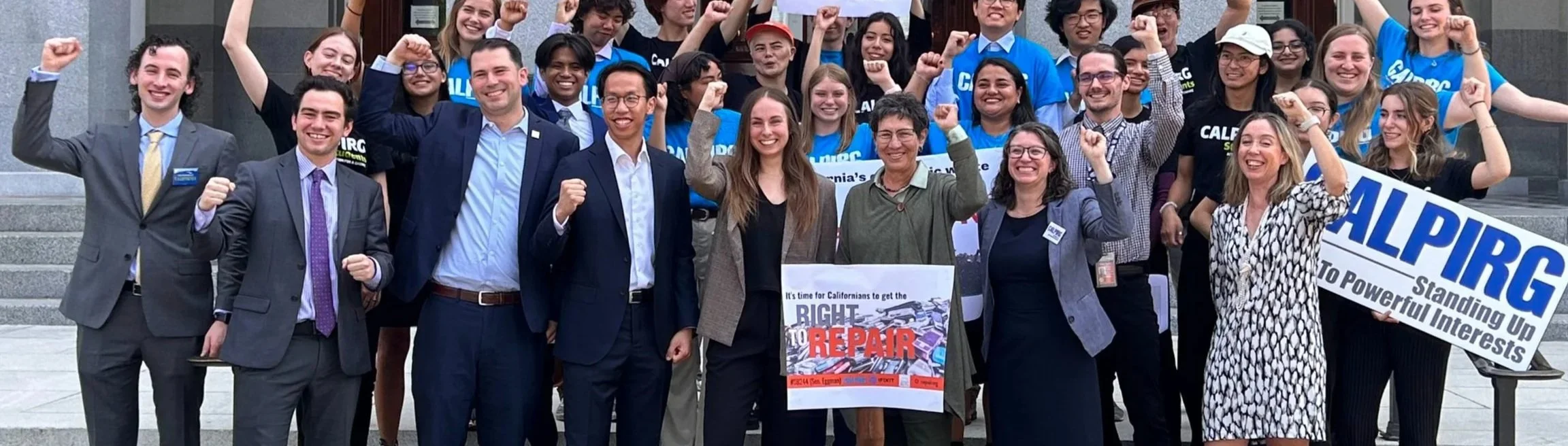
SB 244 will require manufacturers of consumer electronics to provide replacement parts, diagnostic information, and service literature to consumers and third-party repair businesses.
THE ISSUE:
Guaranteeing a "right to repair" will ensure that consumers have the ability to fix the electronics that they own or have them fixed by a technician, preventing much of the electronic waste that gets thrown away every day and saving consumers money.
Position: Co-sponsored by Californians Against Waste, CalPIRG and iFixIt
Contact: Nick Lapis
Status: Signed by the Governor
Current language, analysis, and votes: SB 244

SB 353 adds 100% fruit juice containers over 46oz, and vegetable juice containers over 16oz to the CRV program, creating over 200 million new redemption opportunities annually.
Additionally, the bill addresses two fiscal issues facing CA recyclers. It authorizes CalRecycle to adjust processing payments using a 3 or 12-month average scrap value, whichever number provides a higher payment to recyclers. SB 353 will also provide temporary payments of $60/ton to rural recycling centers to offset the high cost of glass transport and operating costs.
THE ISSUE:
Updating the definition of ‘beverage’ to strike the current exemption for specified juice containers will substantially increase the recycling of the targeted containers and reduce consumer confusion. The bill also addresses the current scrap-value crisis that affects small and medium-volume recycling centers’ financial viability.
Position: Strongly supported by Californians Against Waste
Contact: Mark Murray
STATUS: Signed by the Governor
Current language, analysis, and votes: SB 353

SB 552 (Newman)
OVERVIEW:
SB 552 would have required food facilities to offer food and beverages on reusable foodware for customers dining on-site.
THE PROBLEM:
An estimated 561 billion single-use foodware items are used every year, generating approximately 4.9 million tons of waste. Around 20 percent of this single-use disposable foodware is used by customers dining in at an establishment.
Position: Sponsored by Californians Against Waste
Contact: Nick Lapis
Status: No longer progressing
Current language, analysis, and votes: SB 552
SB 615 (Allen)
OVERVIEW
SB 615 creates a manufacturer-funded collection and recycling system for EV batteries at the end of their useful life.
THE ISSUE
As California proposes to phase out the sale of non-electric vehicles by 2035, the state needs a plan for both handling the batteries at end of life and for reducing the environmental impact of making new batteries.
Position: Strongly supported by Californians Against Waste
Contact: Nick Lapis
Status: 2-year bill. Not heard by Assembly Environmental Safety and Toxic Materials Committee.
Current language, analysis, and votes: SB 615
SB 1167 (Blakespear)

OVERVIEW:
SB 1167 requires large chain restaurants to serve beverages in reusable cups for dine-in customers.
ISSUE:
This bill would expand upon existing efforts to reduce single-use foodware waste, which totals over 849,000 tons per year in California. Disposable cups make up a huge percentage of the most common materials found in waste characterization studies, in large part due to them being difficult to recycle or compost.
Position: Co-sponsored by 5 Gyres, Californians Against Waste, Heal the Bay, & Surfrider Foundation
Contact: Nick Lapis & Krystal Raynes
Status: Dead. Did not receive enough votes to pass Senate Environmental Quality Committee.
Current language, analysis, and votes: SB 1167
SB 353 (Dodd)
OVERVIEW:
SB 1053 (Blakespear & Bauer-Kahan)
OVERVIEW:

SB 1053 would amend current law to no longer allow covered stores to provide ‘thicker’ plastic bags at check stands as a ‘reusable’ bag. Only paper bags will be offered for sale/distribution at check stand.
ISSUE
Following the momentum of local ordinances enacted across the state, SB 270 (Padilla, 2014) was adopted by the Legislature, initiating a statewide phase-out of single-use plastic carryout bags at most food and beverage stores. This legislation included an exemption for thicker plastic bags made of high-density polyethylene, or HDPE.
In 2004, CalRecycle released a waste characterization study and found Californians disposed of 147,038 tons of plastic grocery and merchandise bags, roughly 8 pounds per person. In 2021, that number climbed to 231,072 tons of plastic bags, or 11 pounds per person. What this data shows is that the “plastic bag ban” passed in 2014 did not reduce the overall use of plastic bags and actually resulted in a substantial increase.
Although proponents of HDPE bags will claim they are easily recyclable in California, these bags need to go to specialty recycling facilities. According to a LA Times report, many municipal workers say plastic bags have to be manually removed from the machinery at regular recycling centers and end up in a landfill. Moreover, the LA Times reached out to municipal and city recycling centers around the state and was unable to find a single one that accepts HDPE bags for recycling.
While recent amendments to these bills would mean the law no longer defines standards for reusable bags that may be sold at stores, we believe this measure has the potential to substantially reduce the generation of plastic film carryout bags.
An identical bill, AB 2236 was introduced by Assemblymember Bauer-Kahan in the Legislature this year. With the adoption of SB 1053 by both houses it became unnecessary to advance that measure.
Position: Strongly supported by Californians Against Waste
Contact: Mark Murray & Krystal Raynes
Status: Signed by Governor Newsom
Current language, analysis, and votes: SB 1053